Monday, 4 November 2013

TOP TEN PEACEFUL COUNTRIES OF THE WORLD

Top 10 Peaceful Countries of the World


global peace index 2011 Top 10 Peaceful Countries of the World


Here are outlined the top 10 most relaxing nations around the world of the world according to the Global Peace Index 2013.

10.  Slovenia

Slovenia Top 10 Peaceful Countries of the World
Slovenia, the nation of Central European countries appears as 10th spot as a peaceful nation of 2012 out of 153 nations having 1.358 serenity credit rating at GPI 2012. The number of internal and exterior wars conducted by Slovenia is 1.5 out of 5.

9.  Norway

Norway Top 10 Peaceful Countries of the World
Norwegian has attained 9th spot as peaceful nation of 2012 with 1.356 peacefulness credit rating calculated by peace indicators. From 2009 to 2012, Norwegian has also obtained the highest Human Development Index position on this planet.

8. Canada

Canada Top 10 Peaceful Countries of the World
Canada has very high degree of living in this whole planet. Canada is termed as the 8th spot as peaceful nation of 2012 having a good score of 1.355.

7.  Finland

Finland Top 10 Peaceful Countries of the World
Serenity ranking of Finland according to the GPI 2011 is 1.352 that creates it the 7th spot as peaceful nation of 2012 on the planet.

6.  Austria

Austria Top 10 Peaceful Countries of the World
Austria, the non-coastal country in Central European countries, has taken the 6th spot as peaceful nation of 2012 having 1.337 peacefulness credit rating.

5.  Czech Republic

Czech Republic Top 10 Peaceful Countries of the World
Czech Republic rates a 1.25 governmental volatility and the total of 1.320 serenity credit rating as determined through peace indicators this year becoming the 5th relaxing country of 2012.

4.  Denmark

Denmark Top 10 Peaceful Countries of the World
Having a score of 1.299 scoring for GPI 2012, the Denmark has 4th spot as peaceful nation of 2012.

3.  Japan

Japan Top 10 Peaceful Countries of the World
A Powerful economic supremacy and the smallest rate of inner and exterior situations makes Japan the third most peaceful nation of the planet. It obtained 1.267 peacefulness score at the GPI 2012.

2. New Zealand

New Zealand Top 10 Peaceful Countries of the World
New Zealand is a country of greenery and verdant field. New Zealand has the honour of being second on this list of GPO with a score of 1.287 at peace index.

1. Iceland

Iceland Top 10 Peaceful Countries of the World
Iceland is rated the most relaxing country of 2011 due to low rate of governmental uncertainty, army expenses and the number of internal and external situations conducted this year. It holds 1.048 global peaces rating at the Global Peace Index 2012.

THE MOST PEACEFUL COUNTRY IN THE WORLD

 For Peace & Stability, The U.S. Ranks Last

Gun violence, the war on terrorism, and political divisions in Washington make the United States rank dead last in peace and stability compared to every rich developed nation. According to the Global Peace Index, released on Tuesday, the U.S. ranks even worse than African nations like Tanzania.
If you want peace of mind, dear immigrants, don’t come here, might be the message.
The Index measures the state of peace in 162 countries and is conducted by the Institute for Economics and Peace in New York. The index uses qualitative and quantitative data to gauge internal and external levels of peace on matters such as number of jailed citizens, militarization, political participation and freedom of the press, among other things.
The GPI Report provides an analysis of the Institute’s data, identifying trends in peace over time, as well as the key drivers of peace and an economic calculation of the impact of violence to the global economy.
War and political violence have placed a target on America’s collective backs.  The United States surely isn’t licked yet in comparison to its wealthy friends in Europe, Canada and in the Asian-Pacific rim.
On individual matters, the U.S. scores quite high. On a scale of one to five, with five being least secure, the U.S. scores poorly on gun-related violence, terrorism, overseas conflicts, education spending, and militarization. It does best on adult literacy, civil liberties and — to some this may seem totally ironic, but — the electoral process.
The slideshow below shows the 10 most peaceful countries in the GPI.
Here’s a look at the most peaceful and the least peaceful in certain parts of the world.
North America
Most Peaceful:   Canada                                Most Stressed:  The United States
Latin America
Most Peaceful: Uruguay                                Most Stressed: Colombia
Continental Europe
Most Peaceful: Denmark                               Most Stressed: Russia
Middle East

Most Peaceful: Qatar                                      Most Stressed: Syria
Africa
Most Peaceful: Botswana                              Most Stressed: Somalia
Asia Sub-Continent
Most Peaceful: Bhutan                                   Most Stressed: Afghanistan
Asia-Pacific
Most Peaceful: New Zealand                       Most Stresssed: North Korea

CHINA IN AFRICA


China in Africa: New challenges beyond the commodities super cycle

Image by Mark Ralston AFP/Getty Images
Following the decline in China's demand for commodities during the summer months, its imports of crude oil, copper and iron ore are slowly beginning to recover again. To this day, China's economic relations with Africa are shaped by securing the supply of resources by financing infrastructure and other major projects. There is indeed much to suggest that China's future activities will be more complex and by no means limited to the commodities sector.
Africa's importance for Chinese external trade has increased steadily over the last 10 years. Bilateral trade with African countries grew in 2012 to a volume of US$198bn – with South Africa and Angola topping the list. Although trade with Africa represents a comparatively small share of China's external trade at just over 5%, the rapid increase is not least a reflection of the desire to share in Africa's growth.
In the next five years there are 13 African countries that are likely to join the ranks of the world's 25 fastest growing economies, including commodities exporters such as Nigeria, Zambia and Sierra Leone. This is also reflected by the investment flows to Africa that are increasingly originating in emerging markets. China's stock of direct investments in Africa grew by 34% year-on-year in 2012 to $21.7bn and thus amounted to 4% of total Chinese foreign direct investment. South Africa, followed by Zambia and Nigeria, are the main recipients, but the largest inflows in 2012 were to Angola and the Democratic Republic of Congo.
China's energy requirements remain huge, even though weaker growth, the changeover to alternative energies and reining in coal consumption should curb demand over the medium term.
China is responsible for some 25% of global demand for commodities, while Africa is home to around 10% of global oil reserves and between 40% and 85% of global deposits of gold, chromium and platinum. China covered over 70% of its iron ore needs in 2012 via imports, with South Africa rising up the ladder to become the country's third biggest supplier. For crude oil, China's reliance on imports climbed from 30% in 2001 to 60% in 2012. Africa is therefore of paramount importance when it comes to meeting China's future commodity requirements. But even though the focus remains on securing the supply of commodities there are strong indications that China's activities in Africa will be more varied in future:
Firstly, Africa is becoming increasingly attractive as a market where products can be sold, and not just labour-intensive imported items. Some 18% of Chinese exports to Africa in 2010 were textiles, whereas in 2006 the figure was still about 25%. Machinery and electronics made up the largest share at 29%. With China's move upstream in the value chain, more advanced technologies are proving a good fit for a more demanding clientele and the fast growing market for mobile phones in Africa.
Second, in the manufacturing sector Chinese firms are making more frequent use of local labour and are relying on their own experience of industrial development driven by companies from Taiwan and Hong Kong. Since wage costs in China are rising, it is likely to become more important in future to exploit the differences in wage costs by generating more added value on African soil.
Third, China’s activities in Africa are no longer performed solely via state-owned entities. On the contrary, 45% of China’s direct investments in 2011 came from the private sector, including small and medium-sized enterprises.
Fourth, China can speed up knowledge and technology transfer that benefits both sides via its special economic zones in Africa, though only if (private sector) local decision makers are also involved. The training of local workers will also become essential for China given the growing competition in Africa.
Fifth, the hitherto adopted model, in which Chinese infrastructure projects in Africa – often the critical prerequisite for extracting raw materials – were tied to export guarantees or asset stakes, can no longer be utilised so easily. Until 2008 preferential infrastructure loans were a constant feature of China's foreign policy strategy. However, only a few of the stakes acquired as collateral for infrastructure projects are productive. Despite their substantial financial leeway Chinese state-owned companies will probably have to operate more efficiently in future in order to hold their own against the competition when operating outside their domestic comfort zone.
In all, numerous projects that can decisively advance Africa's industrialisation entail extensive investments and long amortisation periods. China possesses the necessary means to fund such projects. A more complex range of activities will not only provide opportunities for China, but can also generate an increasingly positive contribution to Africa's economic development by establishing better integrated local manufacturing.

DR Congo military attacks last areas held by M23 rebels

DR Congo military attacks last areas held by M23 rebels

Image courtesy of STRINGER/Newscom/RTR
Government forces in the Democratic Republic of Congo say they are attacking the last areas held by the M23 rebel group.
The M23 on Sunday reportedly called a ceasefire to allow peace talks with the government.
According to the BBC, the M23 called on the organisers of the peace talks in Uganda to "put in place a mechanism to monitor the ceasefire".
Government spokesperson Lambert Mende said the statement was "a step in the right direction" but that it was waiting to see if the ceasefire was being implemented.
"There is always a delay between the order being given and the reality on the ground. In any case the army will continue to pursue the demobilisation and disarmament of the rebels," said Mende.
About 800 000 people have been displaced since the fighting began.

The ZUCKERBERG PALACE....LIFE IS THE RICHNESS LIKE THIS

The Zuckerberg Palace Mark Zuckerberg purchased a $7 million dollar house in Palo Alto, California for him and his girlfriend, Priscilla Chan. Billionaire Zuckerberg apparently got a deal and paid $7 million for the 5 bedroom property which came with a spa and large salt water pool. 

Zuckerberg co-founded the social networking site, Facebook, with fellow classmates Dustin Moskovitz, Eduardo Saverin, and Chris Hughes when going to Harvard for college. At such a young age, Zuckerberg is already worth an estimated $7 billion due to his 24% share of Facebook. Zuckerberg is currently CEO & President of Facebook, which has its headquarters nearby Palo Alto.

The house seems very small and cheap for someone who makes billions of dollars. It is interesting to see some billionaires spend less on some of the items they buy. It sorta shows that these people are modest and real human beings. Take a look at photos below!

Mark-Zuckerberg-backyard1 Mark-Zuckerberg-kitchen Mark-Zuckerbergs-bathroom
five+bedroom+house+Palo+Alto+Facebook+Founder+9wu8ZE-bkfnl five+bedroom+house+Palo+Alto+Facebook+Founder+vNrdfa5cDujx
mark mark-zuckerberg Mark-Zuckerberg2

What do you think of his house? Is it to cheap for someone as rich as him? You can answer in the comments below!

THESE ARE CHINISE POACHERS who CAUGHT with IVORIES

KAGASHEKI WITNESSE THE HAUL OF IVORY IMPOUNDED BY THE POLICE, THREE CHINESE NATIONALS ARE IN CUSTODY IN CONNECTION WITH MORE THAN1,800 KG OF TROPHIES

Natural Resources and Tourism minister, Ambassador Khamis Kagasheki, in disbelief as he looks at a pile of elephant trophies impounded at a Mikocheni house in Dar es Salaam, Saturday Nov 2, 2013. Three Chinese nationals Huang Qin, Chen Jinzhan and Xu Fujie are in custody in connection with more than 1,800 kg of trophies
Minister Kagasheki, visits inside the residential house used as a were house to hide natural resources at Mikocheni in Dar es Salaam, Saturday Nov 2, 2013
Armed plain police officer, stand guard outside Mikocheni house in Dar es Salaam late on Saturday, where more than 1,800 kgs of ivory were impounded by the police

At a time when poaching has tremendously scaled up in the country, about 706 pieces of ivory, representing more than 200 tuskers killed, were found yesterday in Dar es Salam Mkocheni area at a residence of Chinese nationals.
The incredulous catch was hidden in a manner that needed informed intelligence to uncover as shells of snails mixed with garlic to fool any suspicious minds sniffing about the ivory. Even the minister for Natural Resources and Tourism, Khamis Kagasheki, and police officers at the scene were so stunned with the ingenuity of the residents, evidently agents of Far East ivory traders.
A detailed report made available to the Guardian on Sunday in past months says China is deeply implicated in the wave of killing of elephants owing to its million dollar trade in ivory products.  The report authored by the Tanzania Elephant Protection Society (TEPS) said rising economic relations between China and Tanzania fuel elephant killings in the country, calling for proper
government intervention.
The document underlined that though the Chinese investments were important in the country’s economy and development, this shouldn’t compromise the country’s natural wildlife conservation efforts. 
The report affirmed that at the current rate of 30 elephants killed every day and 850 elephants shot every month, there is an unprecedented risk of the country’s elephant population perishing in the next seven years.
“China is the number one investor in Tanzania … but the majority of tusks exported illegally from Tanzania end up in China due to the huge demand for ivory in China,”   it said, noting that Tanzania’s partnership with China risks being at the expense of Tanzania’s vital natural resources and the tourist industry,
This requires political will and strong leadership to resolve, it said, recommending that the Tanzania government “should make investment from China and other countries strictly conditional on China tackling its demand for ivory at home, and stronger law enforcement collaboration to halt the flow of ivory from Tanzania to China.”
Three Chinese, Che Jinzhan, Xu Fujie and Huang Qin, are said to use a special Noah microbus with registration number T713 BXG to transport the ivory pieces to the house.
Until this paper left the house more than 1800 kilogram of ivory pieces were found, although the police were not yet finished with counting.
Inside the house police found a weighing unit that the Chinese used in their illegal business, a number of fresh garlic onions and sacks of shells which were mixed with the ivory during transportation.
Interviewed, the Chinese said that the ivory business is owned by their friends and what they were doing was only the garlic business.
Huang Qin explaining that his friends are the one who used to bring the ivory in their home. He admitted that it is illegal business and if it was in their country they would be executed.
The bus that used to bring the product in the house uses different numbers whereby during a day the used plate number is T713 BXG but at night the number is twisted with plate number T 317 BXG.
According to the information released from the ivory storehouse, the minibus is used to conduct the operation at midnight, specifically from 1:00 am.
Briefing the media at the event, minister Kagasheki said they managed to find the ivory as a follow up to Operation Tokomeza against gangs hunting elephants with automatic rifles, all over the country.
Ambassador Kagasheki said the fight against poachers will not be achieved by suspending public officials but by joining efforts with all stakeholders, including MPs to fight the scourge.

The ivory pieces found yesterday represent a big amount as elephants are steadily diminished, he said, underlining that stopping Operation Tokomeza as MPs are proposing would see elephants cleared out from game parks in a few years.
A bag of cash owned by Chinese nationals. the cash was in possession by the arrested Chinese nationals
More than 30 million shillings owned by the arrested Chinese nationals was intended to bribe the corps, according to police sources at the scene
Kagasheki (L), in disbelief, as he led the operation to arrest three Chinese national found with ivory tusk at Mikocheni
Ambassador Kagasheki (L), talks to his Permanent Secretary, Maimuna Tarishi at the scene
Che Jinzhan (R), and Xu Fujie
Ring leader of the arrested Chinese nationals, Huang Qin,
Minister Kagasheki, tour the crime scene
Ambassador Khamis Swed Kagasheki, in a shocking mood
The three Chinese nationals, arrested with more that 1,800 kgs of ivory tusk, wait their fate
This is a makeshift house used to cover the real house used by the Chinese to hide national' resources at Mikocheni in Dar es Salaam
Armed police officer, guard a pole of ivory tusk packed in the sucks at Mikocheni residential house in Dar es Salaam, Saturday Nov 2, 2013.

THE TOP 10 MOST EXPENSIVE WARS


The Top 10 Most Expensive Wars

The Top 10 Most Expensive Wars
Wars have been fought since ancient times. The age-old adage is that wars can never be won, and thus, must never be fought. Sometimes, though, there is a compelling and just reason to wage war, like when Hitler wanted to rule the world. Other times, however, wars are fought merely to help pump up the economy because it would bring about an increased demand for weapons, which in turn, would lead to more employment and humming factories.
There are the human element and the social cost, as well, but these are hard to convert to monetary terms. Wars are certainly expensive, with the amounts spent probably enough to solve the world’s hunger problem several times over. Below is a list of the top ten most expensive wars.
1. World War II  (1941-1945) – $4.1 trillion
 World War 2
World War II actually started in 1939 when Nazi Germany launched a blitzkrieg against Poland. It quickly spread across Europe, as Britain and France declared war on Germany and Benito Mussolini’s Fascist Italy. The United States remained neutral for a while, even as it was still recovering from the Great Depression. In 1941, it finally joined the war on the side of the Allies after Japan surprised it with an attack on Pearl Harbor. Americans were heavily involved in both European and Asian theaters, eventually turning the tide in the Allies’ favor. During this time, the nuclear weapon was created and used for the first time.
2. Post 9-11 (2001-2010) – $1.1 trillion
 Post 9-11
The terrorist attacks in New York and Washington, D.C. on 11 September 2001 led to massive worldwide indignation. The United States quickly responded by going after the group responsible for the attacks, the Al Qaeda and its leader Osama bin Laden. The group and its leadership had been hiding out in Afghanistan where they had accommodating hosts in the Taliban. The hunt for bin Laden finally led to his death in Pakistan in 2011.
Meanwhile, the Americans also waged a war against Iraq for supposedly posing a danger by creating a nuclear weapon. The allegations were refuted not only by Iraq, but also by the United Nations. The Americans pushed on with the war, culminating in the death of Saddam Hussein in 2006.  No evidence was ever found that Iraq even had the capability to build the nuclear bomb.
3. Vietnam War (1965-1975) – $738 billion
 Vietnam War
It was the height of the Cold War, and the Americans were in no mood to give up any country to a communist state. Even if that country was led by unpopular despots who had killed many of his own people, and who had inadvertently been feeding the communist guerillas himself through his tyrannical rule of the people. His unpopularity translated to a similar dislike of the Americans that were waging a war on a people who had done nothing wrong against them. The Americans lost the war, subtly covering it up with a pull out of its forces before it got totally defeated. By that time, American napalm and other weapons had already scarred millions of Vietnamese.
4. Korean War (1950-1953) – $341 billion
 Korean War
At the start of the Cold War, Korea served as one of the first battlegrounds. Korea had been divided into a communist North and the capitalist South, with a border at the 38th parallel. China and the Soviet Union backed the North, while the United States and its allies supported the South. During the height of the war, General Douglas MacArthur seriously considered using the atomic bomb.
5. World War I (1917-1921) – $334 billion
 World War 1
World War I actually began in 1914, but the United States only joined in 1917. Before that, Europe was divided into two camps consisting of the Allied Powers of Britain, France, and others, versus the Central Powers of Germany, Bulgaria, Austria-Hungary and Turkey. The U.S. remained neutral because it believed it would not further its interest if they join the war. They continued trading with both sides. The unlimited submarine warfare policy of Germany, however, had sunk ships with American passengers, and this slowly turned the American public against them. In 1917, the Americans finally entered the war on the side of the Allies. The war ended a year after.
6. Persian Gulf War (1990-1991) – $102 billion
Persian Gulf War
Iraq, under Saddam Hussein, invaded Kuwait in 1990, citing historical claims to the latter that was supposed to be part of Iraq had it not been for a British invention. This threatened the Western world’s oil supply, which was further exacerbated when Hussein started threatening Saudi Arabia. The U.S. then launched Operation Desert Shield, aimed at preventing Iraq from invading Saudi Arabia. This later on became Desert Storm, a war meant to free Kuwait that was seen by the rest of the world on CNN.
7. Civil War (1861-1865) – $79.7 billion, 59.6 Union
 Civil War
The Civil War pitted the Union states opposed to slavery against the Confederate states that were pro-slavery. It pitted Americans against other Americans in a war that split the nation. While it cost the nation a lot, it was also a fight that needed to be fought, though white extremists would continue lynching African-Americans until well into the 20th century. The Union spent nearly $60 billion for the war, while the Confederacy used up almost $20 billion in current money.
8. Spanish-American War (1898-1899) – $9 billion
Spanish-American War 
Spain then was in control of Cuba, which was just off Florida. Washington demanded that Spain turn over control to the U.S. When Spain rejected the demand, the Spanish-American War erupted. This started American expansionist policy, as they took over Cuba, Puerto Rico, Guam and the Philippines.
9. American Revolution (1775-1783) – $2.4 billion
 American Revolution
It was a conflict between the 13 colonies and the British crown, as Americans demanded equal rights. The disagreement on how they should be treated resulted into a cry of No Taxation Without Representation.  It took eight years, with the war ending with the Treaty of Paris in 1783. By that time, the United States was already an independent country.
10. Mexican War (1846-1849) – $2.37 billion
 Mexican War
It erupted after the U.S. annexed Texas in 1845. It eventually occupied New Mexico and California, before capturing Mexico City. The war forced Mexico to give Alta California and New Mexico to the Americans for $15 million and the American’s assumption of $3.25 million in debt that Mexico owed to U.S. citizens.

Syria War Cost Industry $2.2 Billion

Syria War Cost Industry $2.2 Billion
Agence France Presse  |  By Posted:   |  Updated: 11/03/2013 2:25 pm EST
The Syrian industrial sector has lost $2.2 billion since the war began 31 months ago, Industry Minister Kamaleddine Tohme said in statements published Sunday.
"The losses in the industrial sector from the start of the Syrian crisis till October total 336 billion Syrian pounds ($2.2 billion)," the pro-regime newspaper Al-Watan quoted Tohme as saying.
The private industrial sector has lost $1.5 billion, while public industry has lost $700 million, he said.
But he insisted that the figures did not reflect losses incurred in parts of the country held by rebel groups fighting to topple the regime.
More than 120,000 people have been killed in Syria's war, and millions more forced to flee their homes.
It has also destroyed the economy, causing soaring inflation and driving down the value of the Syrian pound.
According to the UN, more than half the Syrian population is now living in poverty.

OPPOSITION LAYS PRECONDITIONS FOR PEACE TALKS TO END WAR-SYRIA

Syria crisis: Opposition lays preconditions for peace talks to end civil war

The Syrian opposition set terms on Sunday for attending peace talks to end the Syrian civil war, in a move that throws the proposed conference into further confusion after the international envoy said there should be no preconditions.

The long-delayed talks - known as Geneva 2 - are meant to bring Syria's warring sides to the negotiating table, but have been repeatedly delayed because of disputes between world powers, divisions among the opposition and irreconcilable positions of Assad and the rebels.

Syrian National Coalition President Ahmad Jarba said the opposition would not attend unless there was a clear timeframe for President Bashar al-Assad to leave power. He also said they could not accept the presence of Iran.

"We have decided not to enter Geneva talks unless it is with dignity, and unless there is a successful transfer of power with a specific timeframe, and without the occupier Iran at the negotiating table," Jarba told an Arab League emergency meeting of foreign minister in Cairo.

Lakhdar Brahimi, the international envoy for Syria, has said he hoped the conference could still be held in the next few weeks despite obstacles.

Though he had in the past said he thought Assad would not be part of a transitional government that Geneva 2 would attempt to install, he said on Friday that his opinions had no bearing on the parameters for the conference.

There is also discord among world powers over whether Iran should be invited to the talks. Tehran has said it is ready to come and Brahimi says the U.N. preferred that Iran attend but there had been no agreement on that yet.

A senior State Department official, speaking ahead of U.S. Secretary of State John Kerry's visit to Cairo and Riyadh, said the top U.S. diplomat would make clear to the Saudis that Iran would not be welcome to attend the Syria peace talks unless it endorsed a past agreement that would see Assad give up power.

"Iran has not done that, and without that even we couldn't consider the possibility of their participating," the official added, stressing: "It is a question of just making sure they understand the details of how firm our position is."

CALL FOR WEAPONS

In Cairo, an Arab League draft communiqué called on the Syrian opposition to attend the conference.

"It (Arab League) decided to call on all sides of the Syrian opposition under the leadership of the Syrian National Coalition ... to accelerate the formation of the negotiating delegation".

In Cairo, Jarba urged world powers to supply Syrians fighting Assad with weapons in the conflict that has so far claimed the lives of more than 100,000 people.

"We demand a clear decision on supplying the Syrian people with weapons to fight the hostility which gets worse hour by hour ... We guarantee that these weapons will not fall into the wrong hands."

The growing influence of radical Islamist fighters and the disarray of rebel forces have made Western powers wary of intervening directly in the civil war by supplying weapons or troops.

While some rebel tensions stem from contrasting ideological outlooks, most infighting centers around rival claims over the control of territory, smuggling and other spoils of war.

Arab and Western officials have said that international powers were unlikely to meet their goal of holding the conference in November.

Even if Jarba were to attend the Geneva 2 meetings, he has no authority over the rebel brigades battling to overthrow Assad.

The main rebel brigades have announced their opposition to the conference if it does not result in Assad's removal.

GIANT JESUS STATUE ARISES in SYRIAN WAR

In midst of Syrian war, giant Jesus statue arises

Associated Press
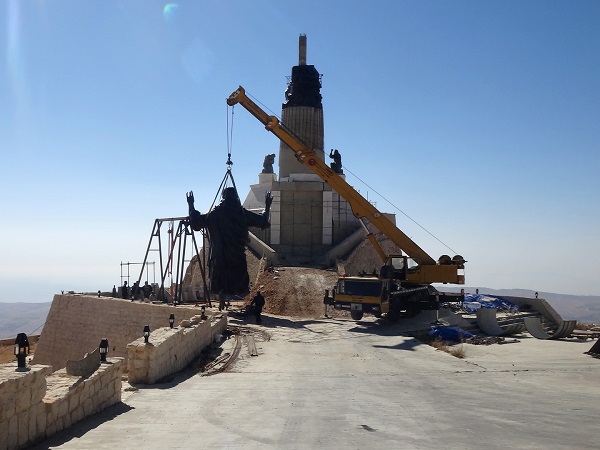
This Oct. 14, 2013 photo provided by the St. Paul’s and St. George’s Foundation shows workers preparing to install a statue of Jesus on Mount Sednaya, Syria. In the midst of a civil war rife with sectarianism, a 12.3-meter (40-foot) tall, bronze statue of Jesus has gone up on a Syrian mountain, apparently under cover of a truce among three factions – Syrian forces, rebels and gunmen in the Christian town of Sednaya. AP/Samir El-Gadban, St. Paul’s and St. George’s Foundation
BEIRUT — In the midst of a conflict rife with sectarianism, a giant bronze statue of Jesus has gone up on a Syrian mountain, apparently under cover of a truce among three factions in the country’s civil war.
Jesus stands, arms outstretched, on the Cherubim mountain, overlooking a route pilgrims took from Constantinople to Jerusalem in ancient times. The statue is 12.3 meters (40 feet) tall and stands on a base that brings its height to 32 meters (105 feet), organizers of the project estimate.
That the statue made it to Syria and went up without incident on Oct. 14 is remarkable. The project took eight years and was set back by the civil war that followed the March 2011 uprising against President Bashar Assad.
Christians and other minorities are all targets in the conflict, and the statue’s safety is by no means guaranteed. It stands among villages where some fighters, linked to al-Qaida, have little sympathy for Christians.
So why put up a giant statue of Christ in the midst of such setbacks and so much danger?
Because “Jesus would have done it,” organizer Samir al-Ghadban quoted a Christian church leader as telling him.
The backers’ success in overcoming the obstacles shows the complexity of civil war, where sometimes despite the atrocities the warring parties can reach short-term truces.
Al-Ghadban said that the main armed groups in the area — Syrian government forces, rebels and the local militias of Sednaya, the Christian town near the statue site — halted fire while organizers set up the statue, without providing further details.
Rebels and government forces occasionally agree to cease-fires to allow the movement of goods. They typically do not admit to having truces because that would tacitly acknowledge their enemies.
It took three days to raise the statue. Photos provided by organizers show it being hauled in two pieces by farm tractors, then lifted into place by a crane. Smaller statues of Adam and Eve stand nearby.
The project, called “I Have Come to Save the World,” is run by the London-based St. Paul and St. George Foundation, which Al-Ghadban directs. It was previously named the Gavrilov Foundation, after a Russian businessman, Yuri Gavrilov.
Documents filed with Britain’s Charity Commission describe it as supporting “deserving projects in the field of science and animal welfare” in England and Russia, but the commission’s accounts show it spent less than 250 pounds ($400) in the last four years.
Al-Ghadban said most of the financing came from private donors, but did not supply further details.
Russians have been a driving force behind the project — not surprising given that the Kremlin is embattled Assad’s chief ally, and the Orthodox churches in Russia and Syria have close ties. Al-Ghadban, who spoke to The Associated Press from Moscow, is Syrian-Russian and lives in both countries.
Al-Ghadban said he began the project in 2005, hoping the statue would be an inspiration for Syria’s Christians. He said he was inspired by Rio de Janeiro’s towering Christ the Redeemer statue.
He commissioned an Armenian sculptor, but progress was slow.
By 2012, the statue was ready, but Syria was aflame, causing the project’s biggest delay, al-Ghadban said.
Majority Sunni Muslims dominate the revolt, and jihadists make up some of the strongest fighting groups. Other Muslim groups along with the 10-percent Christian minority have stood largely with Assad’s government, or remained neutral, sometimes arming themselves to keep hard-line rebels out of their communities.
Churches have been vandalized, priests abducted. Last month the extremists overran Maaloula, a Christian-majority town so old that some of its people still speak a language from Jesus’ time.
On Tuesday a militant Muslim cleric, Sheik Omar al-Gharba, posted a YouTube video of himself smashing a blue-and-white statue of the Virgin Mary.
Al-Ghadban and the project’s most important backer, Gavrilov, weighed canceling it.
They consulted Syria’s Greek Orthodox Patriarch John Yaziji. It was he who told them “Jesus would have done it.”
They began shipping the statue from Armenia to Lebanon. In August, while it was en route, Gavrilov, 49, suffered a fatal heart attack, al-Ghadban said.
Eventually the statue reached Syria.
“It was a miracle,” al-Ghadban said. “Nobody who participated in this expected this to succeed.”

Sunday, 3 November 2013

THIS IS HUMILIATION BY M23

DR Congo rebels accused of atrocities

Government soldiers say bodies were found in freshly dug graves after rebels retreated from base near Ugandan border.
Last Modified: 03 Nov 2013 05:05


Rebels fleeing advancing government soldiers in the Democratic Republic of Congo have been accused of committing atrocities as they retreated.
Government troops told Al Jazeera on Saturday that they had discovered freshly dug graves in the last stronghold of the M23 rebels, close to the Ugandan border.
Al Jazeera's Malcolm Webb was shown one such grave at the Rumangabo base and said it looked like a man buried there had been executed.
"It looks like he was tied up, with his arms behind his back, and his legs tied together, at the moment he died," he said. "There’s some blood coming from his head, so it really looks like he was executed."
Some fighters who surrendered after government forces moved in said the rebel group killed its prisoners before it left.
Al Jazeera talks to Ambassador Herman Cohen
People living in the villages around the base told Al Jazeera that living conditions under the rebels had been harsh.
"They would beat people for nothing, and they would arrest people and make them disappear," one woman said.
On Friday, the government urged rebel fighters who had fled into the hills to surrender and avoid a final offensive to wipe them out.
About 200 die-hard fighters were holed up in the mountains, at an altitude of about 2,000 metres, near the eastern town of Bunagana, said government spokesman Lambert Mende.
After more than a week of heavy fighting around the town in the lush green, hilly region bordering Uganda, army spokesman Olivier Amuli told AFP the rebels were "caught in a vice".
"We are giving a final chance to all M23 fighters to surrender," Amuli said, as the army carried out operations in a bid to put an end to an armed uprising in the restive North Kivu province.
Thousands fleeing
UN patrols on Friday streamed through on the road leading to Bunagana, a small town without electricity or running water, secured by about 100 army troops.
About 5,000 people have taken refuge across the border in Uganda since the beginning of the week according to the UN's refugee agency.
Bunagana mayor Leon Bitegeka said "streams of people continue to cross into Uganda" due to the heavy fighting which began eight days ago.
The M23 are mainly ethnic Tutsis and were once part of the country's army, but mutinied last year, accusing the government of not honouring a 2009 peace deal.
The fighting stopped earlier this year, but restarted last month after peace talks broke down.
The world's largest UN peacekeeping force is in Congo, helping the government fight M23. Rwanda and Uganda have been accused by Congo's government and the UN of backing the rebel forces, but have repeatedly denied the allegations.
While no death tolls from the latest fighting have been released, the International Committee of the Red Cross said it was treating many wounded and had volunteers collecting and burying the dead.
Source:
Al Jazeera and agencies

LOOK WHAT BOKO-HARAM DID.....Jihadists vs christians

Many killed in Nigeria church stampede

Officials search for cause of stampede at overnight vigil that killed at least 24 people in country's east.
Last Modified: 03 Nov 2013 13:48

At least 24 people have been killed and many more injured in a stampede at the end of a church vigil in eastern Nigeria, officials said.
Nineteen women were amongst the dead at the stampede in the Holy Ghost Catholic Church in Uke, Anambra state on Saturday, where around 100,000 worshippers had gathered for All Souls Day, Red Cross spokesman Peter Kachi told Reuters news agency by telephone.
Authorities did not know what caused the stampede which happened as followers celebrated an overnight vigil to mark All Saints' Day.
"There were too many people and the place was so overcrowded," Osmond Okoli, who narrowly survived being squashed
in the crowd, told local station Channels TV. "We were too compacted so people fell and they were being pushed on us and then we all began to shout from the ground."
The event had been attended hours earlier by the local Anambra state governor, Peter Obi. He later returned to the scene and visited the injured in hospital, promising to set up an inquiry to establish the cause of the accident.
Anambra is about 300km south of Abuja. Religious services gathering several hundred thousand people are common in Nigeria, a country of around 170 million split roughly evenly between Christians and Muslims.
Source:
Agencies

DRC's M23 rebels declare ceasefire

DRC's M23 rebels declare ceasefire

Rebel leader urges all fighters to immediately end hostilities as the country's army takes over their last stronghold.
Last Modified: 03 Nov 2013 15:10

Democratic Republic of Congo's M23 rebels have declared a ceasefire after a 20-month rebellion in North Kivu province to allow peace talks with the government to advance.
Bertrand Bisimwa, leader of the M23 rebel group, urged all fighters on Sunday to "immediately end hostilities" with the government troops.
"We call on the facilitator of the Kampala peace talks to immediately put in place a mechanism to monitor the ceasefire," Bisimwa said in statement.
There was no immediate reaction from the army.
The declaration of the truce came on the day when the government troops said it launched a new offensive against rebel fighters who fled to the hills around Congo's border with Uganda and Rwanda after being ousted from Bunaguna, their last stronghold.
On Friday, Uganda, which has led regional attempts to end the most serious rebellion since Congo's last war ended a decade ago, called for both sides to stop fighting.
Heavy fighting has eased, but the army said it shelled rebel positions on Saturday to encourage fighters to surrender.
Congo's government has dispatched senior negotiators to talks in Uganda, but the army is keen to finish off the rebellion, the last in a series of uprisings led by Congolese Tutsis in the mineral-rich but unstable east.
Source:
Agencie

THE MOST POWERFUL PEOPLE IN THE WORLD

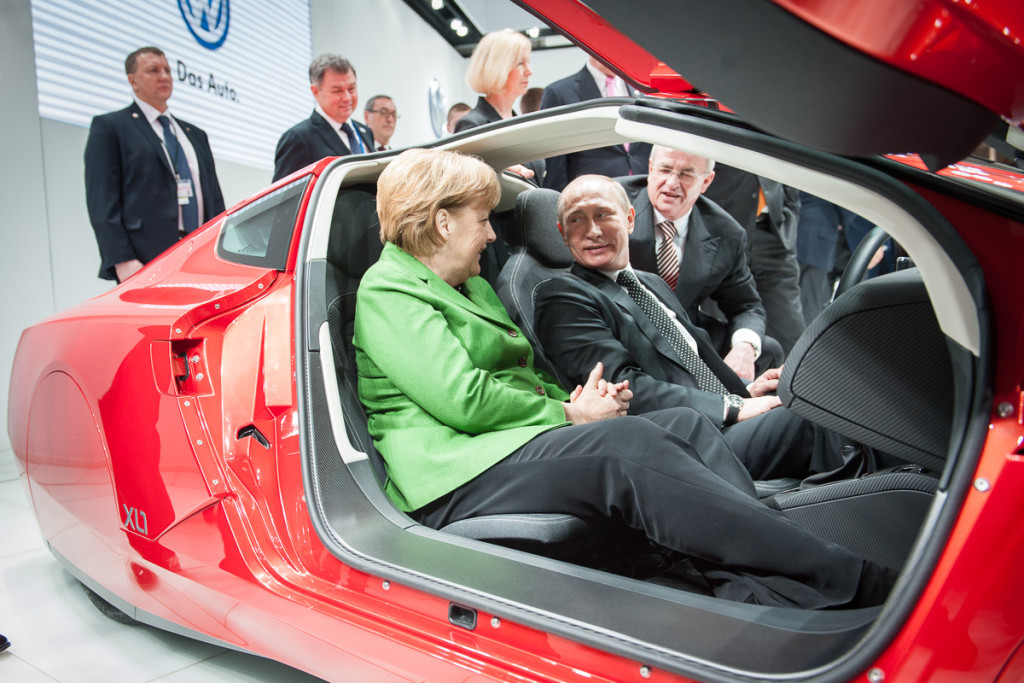
  • Merkel and Putin: Powerful but they don't get along very well (Photo: Bundesregierung/Steins

Forbes: Putin and Merkel most powerful people in the world

31.10.13 @ 09:33

Berlin - Russian leader Vladimir Putin has trumped US President Barack Obama as the most powerful man in the world, while German Chancellor Angela Merkel retains her title as the world's most powerful woman, according to a yearly ranking published by Forbes magazine on Wednesday (30 October).
With his signature healthcare legislation under fire, allies outraged over spying and a barely-averted default on US debt, Obama can no longer be seen as the most powerful man in the world, Forbes editors write.
"It appears that President Obama's lame duck period has set in earlier than usual for a two-term president, causing him to drop one notch from the No. 1 spot," they add.
Meanwhile, the ex-KGB strongman is solidifying his power in Russia "and anyone watching the chess match over Syria has a clear idea of the shift in the power towards Putin on the global stage."
With the possibility of prolonging his presidency until 2024 and with a tight control over the country's oil and gas reserves, Putin has little to worry about when confronted with European or US criticism about human rights in his country.
One of his louder critics, but also the leader of a country with lucrative business relations with Russia, is Germany's Merkel - who for the eighth time in the past 10 years is awarded the title of the "most powerful woman in the world."
"The world's most powerful woman is the backbone of the 28-member European Union and carries the fate of the euro on her shoulders. Fresh off a commanding reelection in September 2013, she has served as ­Chancellor of Germany since 2005 - the first woman in the position," Forbes writes.
Merkel has also climbed in the male-dominated "most powerful people in the world" to the fifth spot, just after Pope Francis and the Chinese leader, Xi Jinping.
Mario Draghi, the head of the European Central Bank, is number nine on that list, followed by UK Prime Minister David Cameron (11) and French President Francois Hollande (18).
Apart from Draghi, no other EU official made it to the 72-strong list.
As for the female ranking, former French finance minister Christine Lagarde, currently head of the International Monetary Fund, is deemed the seventh-most powerful woman in the world. The Queen of the UK ranks 40, after pop stars such Beyonce and Angelina Jolie.
Forbes also did a ranking of the world's top billionaires.
The third richest man in the world is Spain's Armancio Ortega, who owns 60 percent of clothing brand Zara. His wealth is estimated at €41.5 billion. Forbes also notes that he bought valuable properties in Spain "at bargain prices" when the economy collapsed.
The richest man in the world is Microsoft founder Bill Gates (€52 billion), followed by Mexican telecoms chief Carlos Slim Helu (€50 billion).

EU multinationals scamming Africa out of billions, Tanzanian MP says

  • Gold mines in Tanzania are operated by EU-based companies (Photo: Julien Harneis)

EU multinationals scamming Africa out of billions, Tanzanian MP says


31.10.13 @ 09:23
BRUSSELS - Tax avoidance loopholes for EU-based multinationals introduced by the World Bank and the International Monetary Fund (IMF) are said to be costing African countries double the amount they receive in foreign aid.
“It is killing us, you cannot now explain poverty in Africa without this and this is the story that has been supressed for so long,” Zitto Kabwe, an MP who is also chairman of the public accounts committee in Tanzania, told this website on Wednesday (30 October)
He said Tanzania was forced in the late 1990s by the World Bank and the IMF to sign tax rules and tax laws which are favourable to investors, while depriving it of much needed revenue that would help wean it off foreign aid.
Kabwe said EU and other Western multinationals, including a Tanzanian state owned company, use tax havens and other illicit schemes to scam the countries of the continent out of around $50 billion every year.
By comparison, they receive $30 billion in foreign direct aid.
“Almost twice the amount of foreign aid that Africa receives is getting out of Africa through illicit financial transfer, through tax avoidance and the likes,” he said.
A 2011 IMF report on Tanzania, he noted, noted the country is unable to collect taxes due by foreign companies.
“They forgot that they [the IMF] are the ones who provided consultants for us to enact laws that are favourable to investments,” he said.
He noted that the IMF and the World Bank advised African states to design policies and laws which multinational corporations “are abusing to avoid paying taxes in our countries.”
Both institutions, he said, in a twist of events, are now offering advice to stop the abuse.
The IMF, contacted for this story, did not respond to the allegations.
But a possible solution, said Kabwe, is putting an end to double taxation arrangements used by multinationals who funnel their profits into tax havens like the Isle of Man or the British Virgin Islands.
Mining and telecommunications are the two largest sectors in Tanzania where EU-based companies exploit the loopholes for their own benefit.
“Almost all the mining operations in Tanzania are from Europe,” he said.
He noted that African Barrick Gold, which is registered in London, operates the most mines. Another, AngloGold Ashanti, is registered in South Africa but with subsidiaries registered in offshore tax havens, he added.
Three major mobile companies operate in Tanzania. One is based in Dubai, itself a tax haven, and one each registered in the Netherlands and in the UK, he noted.
He said big oil and gas companies like Statoil, Ophir, Shell, and Exxon Mobil are also in Tanzania, but no evidence has surfaced that they are using tax havens, except for the UK-owned PanAfrica Energy and British Gas.
“PanAfrica Energy operate from the Cayman Islands and Mauritius and this is a British government-owned company using tax havens to bring their FDI [foreign direct investments] to Tanzania,” he said.
He noted that the problem is manifold because a Tanzanian state-owned company was itself using a tax haven in Mauritius to avoid filling its own national coffers.
Chinese companies working in Africa, by comparison he said, are more transparent on taxes and pay their dues though they tend to scam on public procurement.
Kabwe, along with a handful of other delegates from Africa organised through the Brussels-based development NGO Eurodad, is set to discuss the issue with the European Commission on Thursday (31 October).
Savoir Mwambwa, from the Nairobi-based Tax Justice Network, said ending the scams orchestrated by EU-based companies would make Africa less dependent on aid.
He said Zambia Sugar, a subsidiary of the British Associated Foods company, would inflate their wage bills by making payments to a ghost branch in Mauritius.
“One common thing about all these companies, if you look at all the instruments they use, they all have businesses in one form or another in tax havens,” said Mwambwa.
The EU, for its part, has proposed reforms on accountancy and transparency directives.
The reforms, backed by the European Parliament in June, would require companies in the extractive and logging sector to publish an annual report disclosing the details of tax, bonuses and other payments made to governments for every project they operate over a $100,000 threshold.
The move drew praise from Oxfam, which said it would help fight tax dodging by EU companies in the developing world.
The reformed EU law is set for launch in 2015