Jacqueline Walls |
09/08/2013
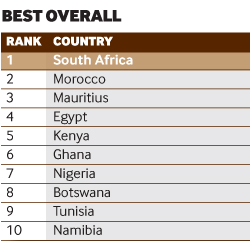
South Africa has been crowned as the African Country of the Future for 2013/14 by fDi Magazine,
with Morocco in second position and Mauritius in third. New entries
into the top 10 include Nigeria and Botswana. Jacqueline Walls reports.
One of the economic powerhouses of the African continent, South Africa has been named fDi
Magazine’s African Country of the Future 2013/14. A worthy winner,
South Africa has consistently outperformed its African neighbours in FDI
attraction since fDi Markets records began in 2003. Figures for
2012 build upon South Africa’s historical prominence as an FDI
destination with the country attracting about one-fifth of all
investments into the continent – more than double its closest African
rival, Morocco. In 2012, FDI into South Africa amounted to $4.6bn-worth
of capital investment and the creation of almost 14,000 jobs.
In
the five years or so since the financial crisis made its impact felt,
global FDI remains 20% lower than figures recorded in 2008. Any hints of
global recovery in FDI in 2010 and 2011 have been overshadowed by the
14.3% decline in 2012. In the context of this decline, the number of
investments into the African continent fell to a lesser extent than any
other world regions, down 7.9% in 2012. However figures for the first
five months of 2013 signal that FDI into Africa is falling at about the
same rate as global averages, down 27% compared to 28% globally.
Unrest,
corruption and severe income disparities persist in Africa, though an
emerging middle class with increased disposable income, a marked
improvement in governance and the availability of natural resources
present an attractive opportunity for investors. According to a recent
report by the African Development Bank, Africa’s economy is growing
faster than any other continent. Of the 54 African countries, 26 have
now achieved middle-income status, with some countries, such as South
Africa, Morocco and Mauritius, significantly outperforming the likes of
Somalia and the Democratic Republic of Congo.
South Africa's resilience
South Africa claimed the title of
fDi’s
African Country of the Future 2013/14 by performing well across most
categories, obtaining a top three position for Economic Potential,
Infrastructure and Business Friendliness. Its attractiveness to
investors is evident in its recent FDI performance, where the country
defied the global trend with 2011 and 2012 figures surpassing its
pre-crisis 2008 statistics. Despite a slight decline of 3.9% in 2012,
South Africa increased its market share of global FDI, which further
increased in the first five months of 2013 as the country attracted
1.37% of global greenfield investment projects. According to
fDi Markets, South Africa now ranks as the 16th top FDI destination country in the world.
South
Africa’s largest city, Johannesburg, was the top destination for FDI
into Africa and is one of only five African cities that attracted more
investments in the first five months of 2013 compared to the same period
of 2012. South Africa ranked third behind the US and the UK as a top
source market for the African continent in 2012, accounting for 9.2% of
FDI projects.
In 2010, South Africa became the ‘S’ of the BRICS –
five major emerging national economies made up by Brazil, Russia, India
and China. While FDI into South Africa fell 3.9% in 2012, this was the
lowest recorded decline of the BRICS grouping which, on average,
experienced a 20.7% decline in FDI. In its submission for
fDi’s
African Countries of the Future 2013/14, Trade and Investment South
Africa (TISA) stresses the importance of the country's attachments to
its BRICS partners. “South Africa’s participation in the BRICS grouping
is significant… as it provides important opportunities to build South
Africa’s domestic manufacturing base, enhance value-added exports,
promote technology sharing, support small business development and
expand trade and investment opportunities,” says TISA.
Familiar look at the top
South
Africa, Morocco and Mauritius have maintained their top three positions
in the ranking, though Morocco has been ousted from the top spot in
part due to its 17% FDI decline in 2012. Home to the Tangier Free Zone
(ranked sixth in
fDi’s Global Free Zones of the Future 2012/13),
Morocco still provides a healthy FDI story, attracting 8.3% of all
investments into Africa last year. The country ranked second in the
Infrastructure category and joint top for FDI Strategy.
Egypt
ranks fourth in fDi’s African Countries of the Future 2013/14 table.
However, as these results went to press, turmoil erupted in the country
following the ousting of its president, Mohammed Morsi. As
fDi
Magazine’s African Countries of the Future ranking is primarily based on
the analysis of FDI data, it is important to note that prior to the
current political situation, the country had witnessed a 20% increase in
inward investment in 2012.
Kenya has climbed the overall
rankings, moving from 10th in the 2011/12 ranking to fifth position this
year. Since 2008, FDI into the country more than doubled and the latest
figures from
fDi Markets show that Kenya has already attracted
9.43% of inward investment into Africa in the first five months of 2013.
Currently, Kenya ranks second behind South Africa as the top FDI
destination in 2013. Kenya continues to diversify its economy and the
widely adopted use of M-Pesa mobile payment has opened the door to many
new investment opportunities. Nigeria and Botswana are the new entrants
in the top 10, ranking in seventh and eighth place, respectively.
Places of potential
South
Africa is top of the Economic Potential table. The country's GDP stands
at more than $5.8bn and it is the largest economy in Africa. South
Africa has attracted more R&D investments than other African country
and accounts for the largest number of patents registered in the
continent. Exports from the country increased 24% in 2011 whereas
imports increased 18% when compared to 2010 figures, and both were more
than 13% higher than 2008 levels.
Nigeria comes in second behind
South Africa in the Economic Potential category. Despite major issues
such as corruption, security and infrastructure inadequacies blighting
the country in recent years, Nigeria has seen its GDP almost treble
since the turn of the century. According to the Nigerian Investment
Promotion Commission’s submission for
fDi’s African Countries of
the Future, the Nigerian government is keenly aware that major issues
need to be tackled in order for the country to unlock its potential. To
address this, it says the government has “implemented various
improvement measures in order to reach its goal of being one of the
world's 20 largest economies by 2020.”
Following a slight decline
in FDI in 2009/10, investments into Nigeria increased 41% in 2011 and a
further 20% in 2012. The oil industry is a dominant feature of the
Nigerian economy, though the communications sector is also a strong area
of growth. According to
fDi Markets, FDI in the communications
sector accounted for one-quarter of all investments in the country in
2012, and as penetration levels remain relatively low in this large and
growing consumer market, this sector continues to offer huge
opportunities to existing and new players alike.
A new entrant
into the top 10 for Economic Potential, Kenya ranked third thanks
largely to its strong performance in FDI attraction. Kenya’s capital,
Nairobi, was the fastest growing African city for FDI between 2009 and
2012 and was second only to Johannesburg as a destination for FDI in
2012. Many initiatives are currently being developed to drive the Kenyan
economy and in turn encourage investors into the country. In its
submission for fDi’s African Countries of the Future, KenInvest says:
“The development of the national investment policy… is aimed at
streamlining the investment promotion and facilitation process in Kenya
to make it simpler. Full implementation of the… new constitution is on
its own expected to increase the level of foreign participation in the
country”.
A well-administered country by regional standards, Ghana ranks fourth in the Economic Potential category of
fDi’s
African Countries of the Future 2013/14. In the past few years, Ghana
has attracted its largest ever FDI project following the discovery of
major offshore oil reserves in 2007. In July 2009, South African company
New Alpha Refinery announced plans to construct a new $6bn oil refinery
in Accra in what will be the largest refinery in west Africa. With
production set to begin in 2015, the refinery should initially produce
200,000 barrels of oil per day with a view to eventually doubling
capacity.
Labour and costs
Mauritius tops the table
in Africa when it comes to the Labour Environment category. With a
reputation for political and social stability, Mauritius is recognised
as a middle-income country with a greater degree of equality compared
with other African nations. High-end FDI has been a boon to Mauritius,
with more than half of all inward investment involved in the business
and financial services sectors. On its own, Mauritius's financial
services sector accounts for 13% of the country's GDP and directly
employs more than 15,000 highly skilled professionals.
Tunisia
ranks second in the Labour Environment category. Currently undergoing
great social and political change, Tunisia has one of the top tertiary
education enrolment rates in Africa, combined with a comparatively high
life expectancy. Being home to eight of Africa’s top 200 universities
has helped Egypt place in third, while Algeria and Libya complete the
top five.
Madagascar is the leading African country in the Cost
Effectiveness category. Low wages combined with low property costs have
helped Madagascar attract investors involved in manufacturing and
extraction, with these activities accounting for 40% of investments on
the island. One of the world's poorest countries, Mauritania is in
second place in this ranking. Although rich in natural reserves, the
country has been unable to capitalise on its discovery of oil in 2001.
Infrastructure issues
Despite
the continent experiencing some economic growth, Africa's
infrastructure remains a major constraint that hinders its ability to
unlock its vast human and economic potential. Africa only invests 4% of
its collective GDP in its infrastructure.
Egypt offers one of the
more advanced infrastructure set-ups in Africa, and as such is awarded
the top spot in our Infrastructure category. Prior to the unrest that
the country is currently experiencing, Egypt had a thriving tourist
industry which accounted for more than 10% of its economic output.
Airports in Egypt offer connections to more than 100 international
destinations, and the country is also home to a number of significant
ports due to its strategic location between Europe, Africa and the
Middle East. Egypt also has one of the highest rates of internet usage
in Africa.
Morocco is another African country with a relatively
well developed infrastructure system. Moroccan airports are connected to
more than 80 international destinations and its largest city,
Casablanca, is home to the second largest port in Africa. Future
infrastructure projects for Morocco include a $35bn investment in its
rail networks as well as the development of the world’s largest solar
power plant, which commenced construction in May 2013.
South
Africa is in third place in the Infrastructure category. The South
African government has set out plans to invest $92bn in its
infrastructure over the next three years. The biggest chunk of the
investment will come from the South African electricity utility company
Eskom, and incorporates plans for two new power stations, Medupi and
Kusile, which are expected to start producing electricity in 2014 and
2015, respectively.
Business friendly?
When it comes to business-friendliness, South Africa is
fDi's
top African country. A testament to its open and stable business
environment, the country boasts the highest cluster of knowledge-based
companies. South Africa also recorded the highest number of expansions
in the region on the real-time FDI database, fDi Markets, a clear
indication that business are happy to do business in the country.
Egypt ranks second for business-friendliness, with
fDi
Markets recording nine FDI signals (early-warning signs that a company
may be considering investment) in the past 18 months. Given the
country's current political unrest, it remains to be seen how many of
these projects will come to fruition.
With one of the lowest
corporation tax rates in the region, Mauritius is third for
business-friendliness. According to the latest World Bank Doing Business
ranking, Mauritius is the easiest location in Africa for doing
business, and is positioned 19th globally.
Comparative strategies
Based
on information submitted by African countries with regards to their FDI
strategies, Mauritius and Morocco finish joint top of our FDI Strategy
category.
Promoting itself as "the jewel of Africa", Mauritius is
targeting investors in the financial services, hospitality, property
development, IT and business process outsourcing sectors. In its
submission, the Mauritian Board of Investment (BOI) looks to the future
of the African region, saying: “Since the global investment trend is
gradually shifting towards Africa, BOI is positioning itself to play a
crucial role in positioning Mauritius as the gateway to this new
frontier of growth.”
Morocco’s FDI-friendly environment is
encapsulated in Agence Marocaine de Developpement des Investissements'
African Countries of the Future submission, which says: “With its solid
macroeconomic fundamentals, unique set of free-trade agreements,
competitive labour costs, world-class infrastructure, business-friendly
environment and attractive set of incentives, Morocco has all the
ingredients to become a location of the future.”
One of the
world’s largest producers of diamonds, Botswana enjoys stable economic
growth, low levels of corruption and a stable political regime, one of
the few such success stories in Africa. Botswana Investment and Trade
Centre has recently launched a brand awareness scheme with the slogan
‘Go Botswana’ which it states “highlights our national assets, including
our people, culture, tourism attractions, business potential and our
reputation as a country with good governance.”
Namibia, which is
placed in fourth in the FDI Strategy category, highlighted in its
submission its efforts to realign its strategy in order to attract
future FDI. Its entry states: “To kick-start the process of addressing
Namibia’s economic and business ratings, consultations with World Bank
experts are already under way. We have established the Business and
Intellectual Property Authority (BIPA) to improve service delivery and
the effective administration of business and intellectual property
rights registration by serving as a one-stop centre. The review of our
incentives also cements the country’s commitment to increasing
greenfield and brownfield FDI.”
Africa has experienced significant
growth in the past decade. However this growth should be viewed in
context – the countries on the continent are expanding from a low base
and living standards as well as business environments often do not
measure up to other world regions. Yet this represents an opportunity
for future growth. If the region continues in its efforts to tackle
poverty, corruption, inadequate infrastructures and political issues,
Africa’s competitiveness on a global scale can only get better.
Methodology
To create the shortlist for
fDi African Countries of the Future 2013/14, the
fDi Intelligence division of the Financial Times collected data using the specialist online FDI tools
fDi Benchmark and
fDi Markets
as well as other sources. Data was collected for 55 countries under
five categories: Economic Potential, Labour Environment,
Cost-Effectiveness, Infrastructure and Business Friendliness. A sixth
category was added: FDI Strategy. In this category, 20 submissions were
received from African countries regarding their current strategy for FDI
promotion and this was scored by the judging panel. Countries scored up
to a maximum of 10 points under each individual data point, which were
weighted by importance to the FDI decision-making process in order to
compile both the subcategory rankings, as well as the overall African
Countries of the Future ranking.






 FINLAND Education SYSTEM