The Brighton
seafront, in southern England on October 27, 2013 as a predicted storm
starts to build. (LEON NEAL/AFP/Getty Images)
Advertisement
Weather forecasters warned that the worst storm the United
Kingdom has seen in five years will drench England and parts of Wales
starting Sunday evening.
The UK’s Met Office predicted 20 to 40 millimeters of rain
within six to nine hours overnight and wind gusts exceeding 80 miles
per hour in some areas. Sustained winds of 74 to 95 miles per hour would
make the storm a Category 1 hurricane.
Officials warned that the storm, named St. Jude, could knock down trees, cause flooding and disrupt travel. The UK's Environment Agency issued three flood warnings and 46 flood alerts for England and Wales.
“You could see some pretty gusty conditions, especially for people
traveling in the morning rush hour,” Dan Williams, a spokesman for the
UK’s Met Office, told Bloomberg Businessweek.
“We’d advise people to check the conditions before they go out, look at
local news reports and really consider whether they can delay their
journey for a couple of hours.
The storm is “likely to cause disruption to flights at Heathrow including cancellations,”
London’s Heathrow Airport said in a statement. “Passengers due to
travel on Monday should check the status of their flight with their
airline before traveling to the airport.”
The storm is also expected to hit western France on Sunday night and
Normandy and Nord-Pas de Calais by Monday morning. Mateo France said
wind gusts may exceed 80 miles per hour on the Brittany and Channel coasts.
The Netherlands will experience hurricane-force winds along the coast as well, weather forecasters said.
Chris Burton, a forecaster with MeteoGroup, the weather division of the Press Association, predicted the worst of the fast-moving storm will be over in England by Monday lunchtime.
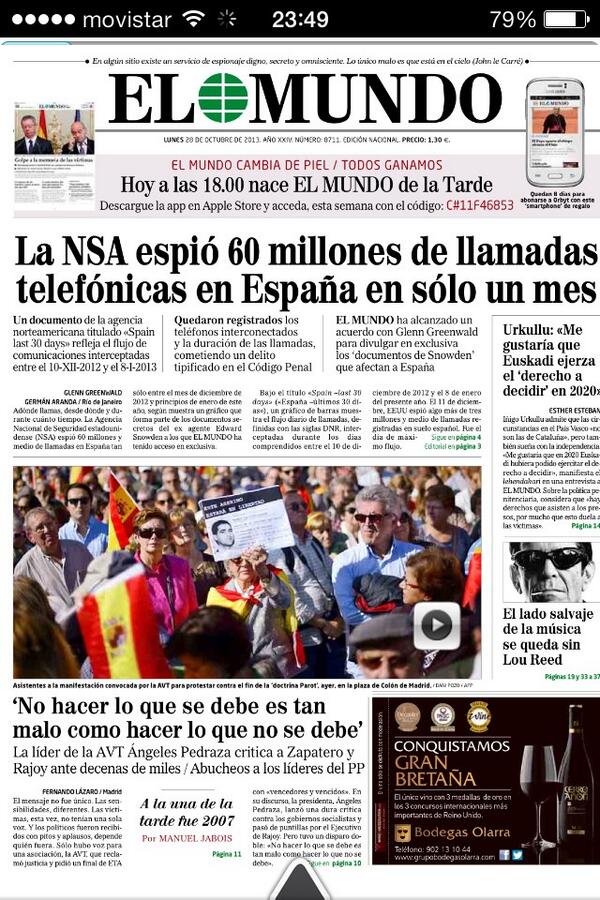
An upcoming story in the Spanish newspaper El Mundo
reports that the U.S. National Security Agency swept up data on 60
million phone calls in Spain over the course of one month in 2012.
This latest revelation comes from documents uncovered by NSA
whistleblower Edward Snowden. The El Mundo story was written by Glenn
Greenwald and Germán Aranda.
Earlier on Sunday, Greenwald teased the story in a tweet:
He later revealed that the country in question is Spain, and he tweeted a screenshot of the story on El Mundo's front page:
This newest surveillance news is likely to further inflame
international tensions surrounding the intelligence reach of the U.S.
government. It comes on the heels of another story co-written by
Greenwald, this one from France's Le Monde newspaper. The Le Monde report indicated that the NSA collected 70 million French telephone records over a 30-day period.
Also this week, a separate story revealed that the U.S. may have bugged the phone of German Chancellor Angela Merkel for over a decade. The NSA has denied reports that Obama was briefed on the matter as far back as 2010 by NSA Director Keith Alexander. Politicians React To NSA Collecting Phone Records
Obama Aware Of Surveillance On Angela Merkel Since 2010: Report
Agence France Presse
|
By
Posted: 10/27/2013 9:20 am EDT | Updated: 10/27/2013 11:20 pm EDT
US President Barack Obama was personally informed of mobile
phone tapping against German Chancellor Angela Merkel, which may have
begun as early as 2002, German media reported Sunday.
Bild am
Sonntag newspaper quoted US intelligence sources as saying that National
Security Agency chief Keith Alexander had briefed Obama on the
operation against Merkel in 2010.
"Obama did not halt the operation but rather let it continue," the newspaper quoted a high-ranking NSA official as saying.
Meanwhile
newsweekly Der Spiegel reported ahead of its Monday issue that leaked
NSA documents showed Merkel's phone had appeared on a list of spying
targets since 2002, and was still under surveillance weeks before Obama
visited Berlin in June.
The spying row has prompted European
leaders to demand a new deal with Washington on intelligence gathering
that would maintain an essential alliance while keeping the fight
against terrorism on track.
Germany will send its own spy chiefs
to the United States next week to demand answers following the
allegations that US intelligence has been tapping Merkel's mobile phone,
as the row threatened to fray transatlantic ties.
Merkel
confronted Obama with the suspicion in a phone call on Wednesday saying
that spying on allies would be a "breach of trust" between international
partners.
The charges also prompted Berlin to summon the US ambassador -- a highly unusual move between the close allies.
The
Frankfurter Allgemeine Sonntagszeitung reported Saturday that Obama had
told Merkel during their call that he had been unaware of any spying
against her. It did not cite its sources.
Der Spiegel said he had told her that if he had been informed of the operation he would have stopped it at once.
Other
media reports said that Obama's National Security Advisor Susan Rice
had also told German officials the president knew nothing of the spying.
Why have young people in Japan stopped having sex?
What happens to a country when its young people stop having sex? Japan is finding out… Abigail Haworth investigates
Abigail Haworth
The Observer,
Arm’s length: 45% of
Japanese women aged 16-24 are ‘not interested in or despise sexual
contact’. More than a quarter of men feel the same way. Photograph: Eric
Rechsteiner
Ai Aoyama is a sex
and relationship counsellor who works out of her narrow three-storey
home on a Tokyo back street. Her first name means "love" in Japanese,
and is a keepsake from her earlier days as a professional dominatrix.
Back then, about 15 years ago, she was Queen Ai, or Queen Love, and she
did "all the usual things" like tying people up and dripping hot wax on
their nipples. Her work today, she says, is far more challenging.
Aoyama, 52, is trying to cure what Japan's media calls sekkusu shinai shokogun, or "celibacy syndrome".
Japan's
under-40s appear to be losing interest in conventional relationships.
Millions aren't even dating, and increasing numbers can't be bothered
with sex. For their government, "celibacy syndrome" is part of a looming
national catastrophe. Japan already has one of the world's lowest birth
rates. Its population of 126 million, which has been shrinking for the past decade, is projected to plunge a further one-third by 2060. Aoyama believes the country is experiencing "a flight from human intimacy" – and it's partly the government's fault.
The
sign outside her building says "Clinic". She greets me in yoga pants
and fluffy animal slippers, cradling a Pekingese dog whom she introduces
as Marilyn Monroe. In her business pamphlet, she offers up the
gloriously random confidence that she visited North Korea in the 1990s
and squeezed the testicles of a top army general. It doesn't say whether
she was invited there specifically for that purpose, but the message to
her clients is clear: she doesn't judge.
Inside, she takes me
upstairs to her "relaxation room" – a bedroom with no furniture except a
double futon. "It will be quiet in here," she says. Aoyama's first task
with most of her clients is encouraging them "to stop apologising for
their own physical existence".
The number of single people has reached a record high. A survey in 2011 found that 61% of unmarried men and 49% of women aged 18-34 were not in any kind of romantic relationship, a rise of almost 10% from five years earlier. Another study found that a third of people under 30
had never dated at all. (There are no figures for same-sex
relationships.) Although there has long been a pragmatic separation of
love and sex in Japan – a country mostly free of religious morals – sex
fares no better. A survey earlier this year by the Japan Family Planning Association
(JFPA) found that 45% of women aged 16-24 "were not interested in or
despised sexual contact". More than a quarter of men felt the same way.
Learning to love: sex counsellor Ai Aoyama, with one of her clients
and her dog Marilyn. Photograph: Eric Rechsteiner/Panos Picture
Many people who seek her out, says Aoyama, are deeply confused. "Some
want a partner, some prefer being single, but few relate to normal love
and marriage." However, the pressure to conform to Japan's
anachronistic family model of salaryman husband and stay-at-home wife
remains. "People don't know where to turn. They're coming to me because
they think that, by wanting something different, there's something wrong
with them."
Official alarmism doesn't help. Fewer babies were born here in 2012
than any year on record. (This was also the year, as the number of
elderly people shoots up, that adult incontinence pants outsold baby
nappies in Japan for the first time.) Kunio Kitamura, head of the JFPA,
claims the demographic crisis is so serious that Japan "might
eventually perish into extinction".
Japan's under-40s won't go
forth and multiply out of duty, as postwar generations did. The country
is undergoing major social transition after 20 years of economic
stagnation. It is also battling against the effects on its already
nuclear-destruction-scarred psyche of 2011's earthquake, tsunami and
radioactive meltdown. There is no going back. "Both men and women say to
me they don't see the point of love. They don't believe it can lead
anywhere," says Aoyama. "Relationships have become too hard."
Marriage
has become a minefield of unattractive choices. Japanese men have
become less career-driven, and less solvent, as lifetime job security
has waned. Japanese women have become more independent and ambitious.
Yet conservative attitudes in the home and workplace persist. Japan's
punishing corporate world makes it almost impossible for women to
combine a career and family, while children are unaffordable unless both
parents work. Cohabiting or unmarried parenthood is still unusual,
dogged by bureaucratic disapproval.
Aoyama says the sexes,
especially in Japan's giant cities, are "spiralling away from each
other". Lacking long-term shared goals, many are turning to what she
terms "Pot Noodle love" – easy or instant gratification, in the form of
casual sex, short-term trysts and the usual technological suspects:
online porn, virtual-reality "girlfriends", anime cartoons. Or else
they're opting out altogether and replacing love and sex with other
urban pastimes.
Some of Aoyama's clients are among the small
minority who have taken social withdrawal to a pathological extreme.
They are recovering hikikomori ("shut-ins" or recluses) taking the first steps to rejoining the outside world, otaku (geeks), and long-term parasaito shingurus (parasite
singles) who have reached their mid-30s without managing to move out of
home. (Of the estimated 13 million unmarried people in Japan who
currently live with their parents, around three million are over the age of 35.)
"A few people can't relate to the opposite sex physically or in any
other way. They flinch if I touch them," she says. "Most are men, but
I'm starting to see more women."
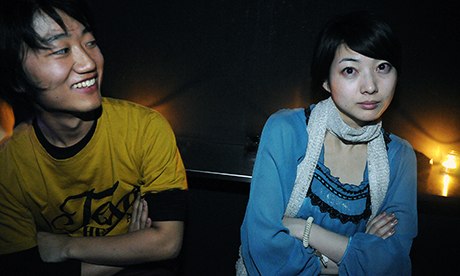
No sex in the city: (from left) friends Emi Kuwahata, 23, and Eri
Asada, 22, shopping in Tokyo. Photograph: Eric Rechsteiner/Panos
Pictures
Aoyama cites one man in his early 30s,
a virgin, who can't get sexually aroused unless he watches female robots
on a game similar to Power Rangers. "I use therapies, such as yoga and
hypnosis, to relax him and help him to understand the way that real
human bodies work." Sometimes, for an extra fee, she gets naked with
her male clients – "strictly no intercourse" – to physically guide them
around the female form. Keen to see her nation thrive, she likens her
role in these cases to that of the Edo period courtesans, or oiran, who used to initiate samurai sons into the art of erotic pleasure.
Aversion
to marriage and intimacy in modern life is not unique to Japan. Nor is
growing preoccupation with digital technology. But what endless Japanese
committees have failed to grasp when they stew over the country's
procreation-shy youth is that, thanks to official shortsightedness, the
decision to stay single often makes perfect sense. This is true for both
sexes, but it's especially true for women. "Marriage is a woman's
grave," goes an old Japanese saying that refers to wives being ignored
in favour of mistresses. For Japanese women today, marriage is the grave
of their hard-won careers.
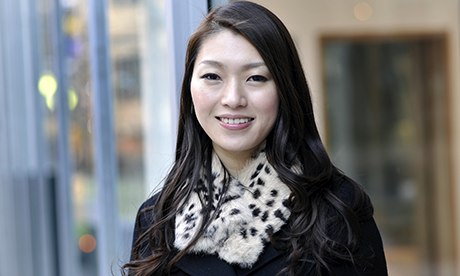
I meet Eri Tomita, 32, over Saturday
morning coffee in the smart Tokyo district of Ebisu. Tomita has a job
she loves in the human resources department of a French-owned bank. A
fluent French speaker with two university degrees, she avoids romantic
attachments so she can focus on work. "A boyfriend proposed to me three
years ago. I turned him down when I realised I cared more about my job.
After that, I lost interest in dating. It became awkward when the
question of the future came up."
Tomita says a woman's chances of
promotion in Japan stop dead as soon as she marries. "The bosses assume
you will get pregnant." Once a woman does have a child, she adds, the
long, inflexible hours become unmanageable. "You have to resign. You end
up being a housewife with no independent income. It's not an option for
women like me." Around 70% of Japanese women leave their jobs after their first child. The World Economic Forum consistently ranks Japan as one of the world's worst nations for gender equality at work. Social attitudes don't help. Married working women are sometimes demonised as oniyome, or "devil wives". In a telling Japanese ballet production of Bizet's Carmen
a few years ago, Carmen was portrayed as a career woman who stole
company secrets to get ahead and then framed her lowly security-guard
lover José. Her end was not pretty.
Prime minister Shinzo Abe recently trumpeted long-overdue plans to increase female economic
participation by improving conditions and daycare, but Tomita says
things would have to improve "dramatically" to compel her to become a
working wife and mother. "I have a great life. I go out with my girl
friends – career women like me – to French and Italian restaurants. I
buy stylish clothes and go on nice holidays. I love my independence."
Tomita
sometimes has one-night stands with men she meets in bars, but she says
sex is not a priority, either. "I often get asked out by married men in
the office who want an affair. They assume I'm desperate because I'm
single." She grimaces, then shrugs. "Mendokusai."
Mendokusai
translates loosely as "Too troublesome" or "I can't be bothered". It's
the word I hear both sexes use most often when they talk about their
relationship phobia. Romantic commitment seems to represent burden and
drudgery, from the exorbitant costs of buying property in Japan to the
uncertain expectations of a spouse and in-laws. And the centuries-old
belief that the purpose of marriage is to produce children endures. Japan's Institute of Population and Social Security reports an astonishing 90% of young women believe that staying single is "preferable to what they imagine marriage to be like".
'I often get asked out by married men in the office who want an
affair as I am single. But I can’t be bothered': Eri Tomita, 32.
Photograph: Eric Rechsteiner/Panos Pictures
The sense of crushing obligation affects men just as much. Satoru
Kishino, 31, belongs to a large tribe of men under 40 who are engaging
in a kind of passive rebellion against traditional Japanese masculinity.
Amid the recession and unsteady wages, men like Kishino feel that the
pressure on them to be breadwinning economic warriors for a wife and
family is unrealistic. They are rejecting the pursuit of both career and
romantic success.
"It's too troublesome," says Kishino, when I
ask why he's not interested in having a girlfriend. "I don't earn a huge
salary to go on dates and I don't want the responsibility of a woman
hoping it might lead to marriage." Japan's media, which has a name for
every social kink, refers to men like Kishino as "herbivores" or soshoku danshi
(literally, "grass-eating men"). Kishino says he doesn't mind the label
because it's become so commonplace. He defines it as "a heterosexual
man for whom relationships and sex are unimportant".
The phenomenon emerged a few years ago with the airing of a Japanese manga-turned-TV show. The lead character in Otomen
("Girly Men") was a tall martial arts champion, the king of tough-guy
cool. Secretly, he loved baking cakes, collecting "pink sparkly things"
and knitting clothes for his stuffed animals. To the tooth-sucking
horror of Japan's corporate elders, the show struck a powerful chord
with the generation they spawned.
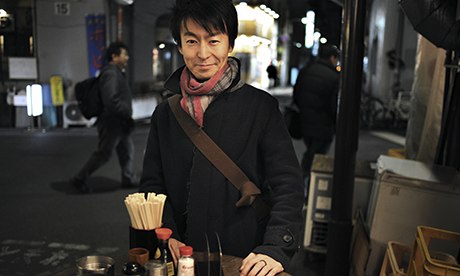
‘I find women attractive but I’ve learned to live without sex. Emotional entanglements are
too complicated’: Satoru Kishino, 31. Photograph: Eric Rechsteiner/Panos Pictures
Kishino, who works at a fashion accessories company as a designer and
manager, doesn't knit. But he does like cooking and cycling, and
platonic friendships. "I find some of my female friends attractive but
I've learned to live without sex. Emotional entanglements are too
complicated," he says. "I can't be bothered."
Romantic
apathy aside, Kishino, like Tomita, says he enjoys his active single
life. Ironically, the salaryman system that produced such segregated
marital roles – wives inside the home, husbands at work for 20 hours a
day – also created an ideal environment for solo living. Japan's cities
are full of conveniences made for one, from stand-up noodle bars to
capsule hotels to the ubiquitous konbini (convenience stores),
with their shelves of individually wrapped rice balls and disposable
underwear. These things originally evolved for salarymen on the go, but
there are now female-only cafés, hotel floors and even the odd apartment
block. And Japan's cities are extraordinarily crime-free.
Some
experts believe the flight from marriage is not merely a rejection of
outdated norms and gender roles. It could be a long-term state of
affairs. "Remaining single was once the ultimate personal failure," says
Tomomi Yamaguchi,
a Japanese-born assistant professor of anthropology at Montana State
University in America. "But more people are finding they prefer it."
Being single by choice is becoming, she believes, "a new reality".
Is
Japan providing a glimpse of all our futures? Many of the shifts there
are occurring in other advanced nations, too. Across urban Asia, Europe
and America, people are marrying later or not at all, birth rates are falling, single-occupant households are on the rise and, in countries where economic recession is worst, young people are living at home. But demographer Nicholas Eberstadt
argues that a distinctive set of factors is accelerating these trends
in Japan. These factors include the lack of a religious authority that
ordains marriage and family, the country's precarious earthquake-prone
ecology that engenders feelings of futility, and the high cost of living
and raising children.
"Gradually but relentlessly, Japan is
evolving into a type of society whose contours and workings have only
been contemplated in science fiction," Eberstadt wrote
last year. With a vast army of older people and an ever-dwindling
younger generation, Japan may become a "pioneer people" where
individuals who never marry exist in significant numbers, he said.
Japan's
20-somethings are the age group to watch. Most are still too young to
have concrete future plans, but projections for them are already laid
out. According to the government's population institute, women in their
early 20s today have a one-in-four chance of never marrying. Their
chances of remaining childless are even higher: almost 40%.
They
don't seem concerned. Emi Kuwahata, 23, and her friend, Eri Asada, 22,
meet me in the shopping district of Shibuya. The café they choose is
beneath an art gallery near the train station, wedged in an alley
between pachinko pinball parlours and adult video shops. Kuwahata, a
fashion graduate, is in a casual relationship with a man 13 years her
senior. "We meet once a week to go clubbing," she says. "I don't have
time for a regular boyfriend. I'm trying to become a fashion designer."
Asada, who studied economics, has no interest in love. "I gave up
dating three years ago. I don't miss boyfriends or sex. I don't even
like holding hands."
Asada insists nothing happened to put her off
physical contact. She just doesn't want a relationship and casual sex
is not a good option, she says, because "girls can't have flings without
being judged". Although Japan is sexually permissive, the current
fantasy ideal for women under 25 is impossibly cute and virginal. Double
standards abound.
In the Japan Family Planning Association's 2013
study on sex among young people, there was far more data on men than
women. I asked the association's head, Kunio Kitamura, why. "Sexual
drive comes from males," said the man who advises the government.
"Females do not experience the same levels of desire."
Over iced
tea served by skinny-jeaned boys with meticulously tousled hair, Asada
and Kuwahata say they share the usual singleton passions of clothes,
music and shopping, and have hectic social lives. But, smart phones in
hand, they also admit they spend far more time communicating with their
friends via online social networks than seeing them in the flesh. Asada
adds she's spent "the past two years" obsessed with a virtual game that
lets her act as a manager of a sweet shop.
Japanese-American author Roland Kelts, who writes about Japan's youth, says it's inevitable that the future of Japanese relationships will be largely technology driven.
"Japan has developed incredibly sophisticated virtual worlds and online
communication systems. Its smart phone apps are the world's most
imaginative." Kelts says the need to escape into private, virtual worlds
in Japan stems from the fact that it's an overcrowded nation with
limited physical space. But he also believes the rest of the world is
not far behind.
Getting back to basics, former dominatrix Ai
Aoyama – Queen Love – is determined to educate her clients on the value
of "skin-to-skin, heart-to-heart" intimacy. She accepts that technology
will shape the future, but says society must ensure it doesn't take
over. "It's not healthy that people are becoming so physically
disconnected from each other," she says. "Sex with another person is a
human need that produces feel-good hormones and helps people to
function better in their daily lives."
Aoyama says she sees daily
that people crave human warmth, even if they don't want the hassle of
marriage or a long-term relationship. She berates the government for
"making it hard for single people to live however they want" and for
"whipping up fear about the falling birth rate". Whipping up fear in
people, she says, doesn't help anyone. And that's from a woman who knows
a bit about whipping.
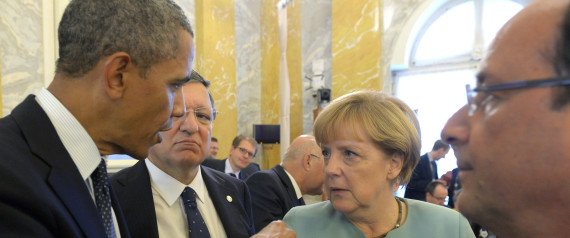
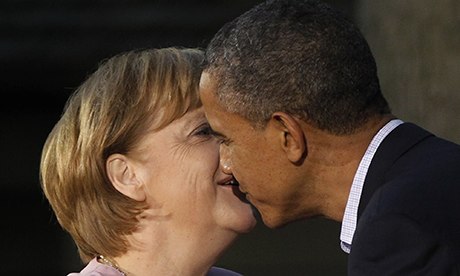
Merkel and Obama:
relationships between leaders can make the difference between success
and failure on the world stage. Photograph: Charles Dharapak/AP
For the third time in a week, Barack Obama has found himself trying to placate the leaders of closely allied nations who have discovered the extent of NSAsurveillance
in their countries. As the flood of spying scandals threatens to engulf
the White House, it has raised the question over whether the
negotiating edge such secret eavesdropping provides is worth the
reputational damage to Washington once it is secret no more, mostly as a
result of the revelations of former NSA contractor Edward Snowden.
With each leak, American soft power haemorrhages, and hard power threatens to seep away with it.
At
the summit level, deal-making is personal. Now that the US under Obama
has acknowledged it cannot act alone on the world stage, relationships
between leaders can make the difference between success and failure. The
recent wrangling over Syria in the UN security council is a recent and
vivid illustration.
Yet nothing could be more personal for a
foreign leader than to find their own mobile phones tapped by a nation
they considered an essential friend and ally. That appears to be the
case for Angela Merkel,
as it has been for Mexico's Enrique Peña Nieto. The other humiliating
phone call of the week was on Monday with François Hollande, whose phone
was not bugged as far as he knew, but who demanded an explanation for
the revelation – once more from the Snowden files – that the NSA had
been recording tens of millions of French phone calls a month. The White
House was forced to admit that the evidence raised "legitimate questions for our friends and allies".
Top of that list of questions is what exactly does it mean to be an American ally in the 21st century. Germany
and France are Nato partners. Their soldiers have fought and died
alongside American troops in Afghanistan. Mexico is fighting a bloody
battle with drug cartels with America and on its behalf.
The
Brazilian president, Dilma Rousseff, whose phone was also monitored by
the NSA, was an American critic but by no means an adversary.
The same sort of questions are being asked of Britain, after the Guardian revealed that GCHQ spied on the delegations
the UK had invited to the lavishly staged G20 summit in London. It
turned out that the handy internet cafe laid on for foreign diplomats
had been rigged up specifically so that GCHQ could read outgoing emails.
Among the targets were the finance minister and other officials from
Turkey, another Nato ally that considered Britain to be its closest
friend in Europe, and a close partner over Syria. Turkish officials say
their faith in the UK is now far more guarded.
Belgium, another
old ally, found evidence its main telecoms provider, Belgacom, had
undergone a powerful cyber attack apparently from GCHQ, in a scheme
codenamed Operation Socialist aimed at "better exploitation" of Belgian
communications.
It is clear from the trove of documents leaked by
Snowden that the only protection against NSA or GCHQ intrusion is
membership of Five Eyes: the US, UK, Canada, Australia and New Zealand.
New
members do not seem to be welcome, and the lesson is that outside that
tight circle, it does not matter how senior you are, and how close a
friend you think you are to Washington or London, your communications
could easily be being shared among the handful of white,
English-speaking nations with membership privileges.
So far, most
of the damage sustained by the US and UK has been reputational and
rhetorical. Some of the accusers, Hollande in particular, are well aware
that their own intelligence services are up to the same tricks, if not
quite so adept and well-equipped. Essential national interests demand
that the core relationship is maintained.
But
there are signs too of deeper damage. Rousseff is calling for the
constructional of a national internet infrastructure that would lock out
US-based corporations, and is trying to rally other emerging powers to
the cause.
The European parliament, meanwhile, has this week
passed legislation, restricting the ability of US telecoms firms to
export European user data to the US, on pain of swingeing fines. Thanks
to Snowden, the advantages offered by American technological dominance
and Britain's position as European gateway to the world's fibre-optic
cables, are beginning to turn into burdens through overuse.
Germany
and France are to spearhead a drive to try to force the Americans to
agree new transatlantic rules on intelligence and security service
behaviour in the wake of the Snowden revelations and allegations of mass
US spying in France and tapping of the German chancellor Angela Merkel's mobile phone.
At
an EU summit in Brussels that was hijacked by the furore over the
activities of the National Security Agency in the US and Britain's GCHQ,
the French president, François Hollande,
also called for a new code of conduct agreed between national
intelligence services in the EU, raising the question of whether Britain
would opt to join in.
Shaken by this week's revelations of NSA
operations in France and Germany, EU leaders and Merkel in particular
warned that the international fight against terrorism was being
jeopardised by the perception that mass US surveillance was out of control.
The
leaders "stressed that intelligence-gathering is a vital element in the
fight against terrorism", a summit statement said. "A lack of trust
could prejudice the necessary co-operation in the field of
intelligence-gathering."
Merkel drove the point home: "We need trust among allies and partners. Such trust now has to be built anew … The United States of America and Europe face common challenges. We are allies. But such an alliance can only be built on trust."
Privately,
according to senior sources who witnessed the two-hour discussion of
intelligence snooping on Thursday evening, Merkel told the other leaders
that the issue at stake was not that her mobile phone may have been
tapped by the Americans, but that it represented "the phones of millions
of European citizens".
While conceding that intelligence services
everywhere might be prone to behaving badly, Hollande dismissed
suggestions that the Americans were merely operating as other security
services also did. He complained that the revelations by the US
whistleblower, Edward Snowden, showed a level of eavesdropping and data
gathering that took place nowhere in Europe and was unique to the US
agency.
A delegation of nine MEPs will travel to Washington on
Monday for a three-day visit, during which they will press senior US
government and intelligence officials for answers on allegations of
widespread spying by the US, and explore "possible legal remedies for EU
citizens" resulting from the alleged surveillance.
Separately,
the German government said on Friday that a group of senior officials
including the heads of its foreign and domestic intelligence agencies
would travel to the US "shortly" for talks at the White House and with
the NSA.
The White House spokesman Jay Carney said the Obama
administration was discussing Germany's concerns "through diplomatic
channels at the highest level".
It is plain that the French and
the Germans want to limit the damage from the NSA furore, but also hope
to engage the Americans to rein in their activities. They set a deadline
of the end of the year for results. The statement said other countries
could join the negotiations, leaving the door open for British
participation.
Given the role of GCHQ
in the mass surveillance, Cameron found himself the target of veiled
criticism at the summit, according to witnesses. Merkel complained that
Britain enjoyed a privileged position with the Americans because it is
the only EU member in the "Five Eyes Club" – the intelligence-sharing
arrangement linking the US, the UK, Canada, Australia and New Zealand.
Senior
EU security officials suspect that Berlin may seek to exploit the
crisis to gain admission to, or at least greater co-operation with, the
Five Eyes pact.
Cameron, sources said, responded to the critical
remarks by stressing that under his premiership the shared intelligence
with the four other countries had resulted in several terrorist plots
being foiled, with countless lives saved.
The controversy deepened
on Thursday when the Guardian revealed that the NSA had monitored the
phone conversations of 35 world leaders after being given their phone
numbers by an official in another US government department. The latest
claims, which emerged from a classified document provided by Snowden,
have further overshadowed this week's EU summit in Brussels.
Despite
US efforts to placate Merkel – including a phone call with the US
president, Barack Obama, on Wednesday – she has refused to conceal her
anger.
Merkel briefed the other leaders in some detail on the
20-minute conversation with Obama, sources said, adding that several
participants commented that they thought the US leader was
"embarrassed".
The European anger and frustration was directed at a
US agency seen to be out of control and beyond appropriate scrutiny
rather than being aimed at Obama.
The latest confidential memo
provided by Snowden reveals that the NSA encourages senior officials in
its "customer" departments – such as the White House, state department
and the Pentagon – to share their Rolodexes so that the agency can add
the phone numbers of leading foreign politicians to their surveillance
systems.
The document notes that one unnamed US official handed
over 200 numbers, including those of the 35 world leaders, none of whom
has been named. These were immediately "tasked" for monitoring by the
NSA.
WASHINGTON |
Sat Oct 26, 2013 8:29pm EDT (Reuters) -
Protesters marched on
Capitol Hill in Washington on Saturday to protest the U.S. government's
online surveillance programs, whose vast scope was revealed this year by
former spy agency contractor Edward Snowden.
People carried signs
reading: "Stop Mass Spying," "Thank you, Edward Snowden" and "Unplug Big
Brother" as they gathered at the foot of the Capitol to demonstrate
against the online surveillance by the National Security Agency.
Estimates
varied on the size of the march, with organizers saying more than 2,000
attended. U.S. Capitol Police said they do not typically provide
estimates on the size of demonstrations.
The
march attracted protesters from both ends of the political spectrum as
liberal privacy advocates walked alongside members of the conservative
Tea Party movement in opposition to what they say is unlawful government
spying on Americans.
"I
consider myself a conservative and no conservative wants their
government collecting information on them and storing it and using it,"
said Michael Greene, one of the protesters.
"Over
the past several months, we have learned so much about the abuses (of
privacy) that are going on and the complete lack of oversight and the
mass surveillance into every detail of our lives. And we need to tell
Congress that they have to act," said another protester, Jennifer Wynne.
The
event was organized by a coalition known as "Stop Watching Us" that
consists of some 100 public advocacy groups and companies, including the
American Civil Liberties Union, privacy group Electronic Frontier
Foundation, Occupy Wall Street NYC and the Libertarian Party.
The
groups have been urging Congress to reform the legal framework
supporting the NSA's secretive online data gathering since Snowden's
disclosure of classified information about the programs that are
designed to gather intelligence about potential foreign threats.
The
Obama administration and many lawmakers have defended the NSA programs
as crucial in protecting U.S. national security and helping thwart past
militant plots. They have also said the programs are carefully overseen
by Congress and the courts.
Snowden's
disclosures have raised concerns that NSA surveillance may span not
just foreign, but domestic online and phone communication.
"We
are calling on Congress to take immediate action to halt this
surveillance and provide a full public accounting of the NSA's and the
FBI's data collection programs," Stop Watching Us said in a letter
addressed to members of Congress posted online, calling for a reform of
the law known as the Patriot Act.
That
law marked its 12th anniversary on Saturday. It was passed in 2001 to
improve anti-terrorism efforts and is now under scrutiny by privacy
advocates who say it allows "dragnet" data gathering.
"Our
representatives in Congress tell us this is not surveillance. They're
wrong," Snowden said in a statement before Saturday's rally. Wanted in
the United States on espionage charges, he is now in temporary asylum in
Russia.
His
latest disclosures showed that the United States may have tapped the
phone of German Chancellor Angela Merkel, adding to the growing outrage
against U.S. data-gathering practices abroad and prompting a phone call
between Merkel and President Barack Obama.
(Reporting by Alina Selyukh and Greg Savoy; Editing by Peter Cooney)
An al-Shabab video told aspiring jihadists to arm themselves from the DIY store B&Q [Creative Commons]
London, UK - Prominent British
Muslims who have spoken out against Islamic extremism say they will not
be cowed despite being targeted by al-Shabab in a broadcast calling for
do-it-yourself attacks by self-styled jihadists in the UK. The video, which appeared on the internet last week and bore
the watermark of the Somali armed group's al-Kataib media wing, is
presented by a black-masked narrator with a southern English accent who
urges aspiring jihadists to arm themselves with knives from B&Q, a
popular DIY or "do it yourself" store famous for the slogan "Don't just
do it, B&Q it". It celebrates the murder of British soldier Lee Rigby in
Woolwich, south London, in May, and accuses Muslim community leaders who
condemned the attack of being on the British government's payroll and
of "mutilating the teachings of Islam".
It didn't make me scared. It just made me angry and more determined
-Ajmal Masroor, imam
Ajmal Masroor, a London-based imam and broadcaster, said police
officers had visited his home late last Wednesday to warn him of a
credible threat against his life made in an online video. "It is a terrible piece of work and the content is vile and
disgusting and horrific in many ways. It is a group of people who are
glorifying violence and death. It didn't make me scared. It just made me
angry and more determined," Masroor told Al Jazeera. Mohammed Shafiq, chief executive of the Ramadan Foundation,
which works to enhance understanding between Muslims and non-Muslims,
said he had also received a visit from police in the early hours. Shafiq told Al Jazeera he was concerned for the safety of his
family, and said police had offered him protection at his Manchester
home. "It's shocked us all but it just makes you even more determined
to make a stand against terrorism," he said. "Not because of what the
government says, but because it is our Islamic duty to stand up against
this. We must confront it wherever we find it." Other figures targeted in the video included Mohammed Ansar, a
filmmaker and broadcaster who regularly challenges both Islamic and
far-right extremism, and Usama Hasan, senior researcher at the Quilliam Foundation, a counter-extremism think-tank. Ansar said police were patrolling his neighbourhood and had
installed alarm systems and reinforced locks and doors at his home.
Summing up his response to the ordeal on Twitter he wrote: "Typical British responses if ever we saw them. Defiance and cups of tea." The video also lists fighters from several British cities
killed on the battlefields of Somalia and features footage of an
al-Shabab member identified as Talha from Tower Hamlets, a London
borough, calling on "all the Muslim men in Britain to come to jihad...
and cut the necks of the disbelievers." Domestic 'terrorism' But it also urges would-be jihadists in the West to consider
taking action closer to home, citing the examples of Woolwich, the
Boston marathon bombings in April, last year's Toulouse killings in
France and the Fort Hood shootings in Texas in 2009.
For them now to openly suggest to Muslims living in other parts of
the world to take up weapons and knives from B&Q... it's too vague.
Somebody is going to do the wrong thing and that is not going to be of
benefit to the jihad or to Muslims.
-Al-Shabab activst
"Just follow the examples of your brothers in Woolwich,
Toulouse, Texas and Boston," the narrator says, brandishing an automatic
weapon. "Do not waste your time trying to reinvent the wheel. If you
can't afford to get hold of one of these then certainly a simple knife
from your local B&Q will do the job." A British-based activist sympathetic to al-Shabab's cause in Somalia said the group, which is a banned terrorist organisation in the UK, had long been a popular destination for British fighters. "Al-Shabab have shown they are a professional force and they
don't mind foreign fighters, so it has become an open ticket for foreign
Muslims to go and fight there. What they are doing in Somalia is
legitimate according to Sharia and they have every right to protect
their territory." But the activist, who did not want to be named, said al-Shabab was making a mistake in trying to incite attacks on British soil. "For them now to openly suggest to Muslims living in other
parts of the world to take up weapons and knives from B&Q... it's
too vague. Somebody is going to do the wrong thing and that is not going
to be of benefit to the jihad or to Muslims. This is something they
need to revisit and look at from a different perspective." Analysts said the video appeared to confirm a shift in
al-Shabab's strategy signalled by last month's Westgate shopping mall
attack in Nairobi away from the group's traditional goal of establishing
Sharia law in Somalia towards carrying out and inspiring al-Qaeda-style
global operations. 'A call to arms' Ahmed Soliman, a Somalia expert at the Chatham House think-tank, said Ahmed Abdi Godane, the current al-Shabab leader who pledged allegiance to al-Qaeda last year, seemed to have won out over factions wary of broadening the struggle beyond Somalia's borders. "Internally there seems to have been quite a bit of upheaval
but what we are seeing now is confirmation that it is this global
jihadist arm that is taking over and dominating. This is a call to arms,
a rallying cry, almost a promotional video," Soliman told Al Jazeera. Soliman said the UK was an obvious target for the group because
of the presence of a sizeable Somali population and because the
government had hosted two high-profile conferences on Somalia which had helped the current transitional government to establish its international credibility. Valentina Soria, an analyst at IHS Jane's Terrorism and Insurgency Centre,
said the video, following so soon after the high-profile Westgate
attack, appeared part of a concerted campaign to recruit fresh fighters
from western countries at a time when al-Shabab was losing ground
domestically and Somalia's appeal as a destination for "jihad tourism"
had been dented by the lure of the war in Syria. "This has boosted their profile in jihadist circles and that is
quite important because the likes of al-Shabab have suffered from the
Syrian conflict and the fact that every jihadist wanted to go to Syria
to fight," she told Al Jazeera. Soria said the Westgate attack and regular bombings inside
Somalia highlighted the threat that al-Shabab continued to pose in East
Africa even as they have suffered strategic defeats on the ground
against combinations of Somali government, African Union, Kenyan and
Ethiopian forces. But she said the video also hinted at the group's more limited
abilities to take the fight to Western countries. "If anything, it is
evidence of an inability to carry out more sophisticated attacks on
their own, so they have to rely on the likes of single extremists." For now though, British Muslims targeted by the group are taking the threat very seriously. Ajmal Masroor said he had received unanimous support after
addressing the threat in his Friday sermon at a central London mosque. "People were saying, 'How dare they?', and even volunteering to
be my bodyguard. So there is a spirit in the community to fight back. I
think it is about time we did more fighting back." Or, as Mohammed Ansar put it on Twitter: "A little odd when an
act of defiance is popping down to the Cafe Nero [sic] with Mrs A for a
coffee and a toasted panini." Follow Simon Hooper on Twitter: @simonbhooper
Dozens of women across country participate in "drive-in" campaign, despite threats and warnings from government.
Last Modified: 27 Oct 2013 02:07
More than 60 women claimed to have answered their
call to get behind the wheel in a rare show of defiance against a ban on
female driving in the ultraconservative kingdom, Saudi activists said.
Saudi professor and campaigner Aziza Youssef said that the group
received 13 videos and another 50 phone messages from women showing or
claiming they had driven on Saturday. She said they had no way to verify
the messages.
If the numbers are accurate, this year's campaign is the most successful effort yet by Saudi women demanding the right to drive.
Youssef said they had not received any reports of arrests or women being ticketed by police.
A security official said that authorities did not arrest or fine
any female drivers on Saturday. He spoke on condition of anonymity
because he was not authorised to speak to the media.
A website set up by the campaigners, Oct26driving.com, in the hope of getting more women on the roads, appeared to have been hacked.
It read in Arabic, "This site has been hacked because I am against women driving in this holy country."
The Interior Ministry on its website said: "While Saudi regulations
ban any offence to social peace that opens the door to sedition, the
Ministry of Interior emphasises to all that authorities will follow the
law decisively against violators."
"At the same time, the government appreciates calls by citizens to
respect security and to stay away from any attempt to divide society." 'Suspicious cars'
The campaign happened despite several roadblocks along the way during the past few days.
Youssef said she and four other prominent women activists received
phone calls this week from a top official with close links to Interior
Minister Prince Mohammed bin Nayef, warning them not to drive on
Saturday.
She also said that "two suspicious cars" were following her all day.
"I don't know from which party they are from. They are not in a
government car," she said.
The activists changed the original plan to drive only on Saturday to make the campaign open-ended, in response to the threats.
Though no specific Saudi law bans women from driving, women are not
issued licenses. They mostly rely on drivers or male relatives to move
around.
Clerics who hold far-reaching influence over the monarchy enforce the
driving ban, warning that breaking it will spread "licentiousness".
Somalia is one of the most dangerous places in the world to be journalist [Reuters]
Somali government security forces have raided Shabelle Radio station in the Somali capital, Mogadishu, Al Jazeera has learned.
The Somali-owned private station, considered the most popular and
influential domestic station in the country, went off air shortly after
the raid on Saturday.
According to the government, the station was shut down because it was
occupying a government building that needed to be vacated and adequate
time was given to the owners to find alternative premises.
"We gave them notice in July to vacate the government building they
were occupying. When the first notice expired we gave them a second
notice which expired yesterday." Mahdi Mohamud, Somalia's state minister
for interior and national security, told Al Jazeera.
"We cannot keep on waiting for them. The government needs the building." the minister added.
But the station management strongly disagree with the government's explanation for the raid.
The government's excuse was rejected by the director of the radio
station, who claimed that the cause of the closure was
politically-motivated.
"This is about silencing Radio Shabelle. This is politics and has
nothing to do with the premises. We only received one letter and we
received it five days ago." Abdimalik Yusuf Mohamud, Radio Shabelle
director, told Al Jazeera shortly after he was released from prison. Journalists arrested
All Shabelle staff,
including the security guards, were arrested during the raid. According
to government officials, the arrests took place as a final resort when
staff refused to vacate the premises, denying that the move aimed at
silencing the station.
"That is not true. The soldiers broke down our gate with their
vehicle and arrested all 36 journalists. They beat us up with the back
of their guns and took all our cameras and laptops. They even broke into
the safe and took $300,000." said Mohamud.
Reacting to the raid and the shutdown, the National Union of Somali Journalists described the incident as "unfortunate".
"We are sad about what happened to our colleagues. We request the
government to release the journalists without any conditions and as soon
as possible," Mohamed Ibrahim, the union's general secretary, said.
Radio Shabelle, housed near Mogadishu airport, is located in one of the most secure areas in the capital.
The station, which has lost
more than ten journalists in the last 10 years after attacks by unknown
gunmen, is known for broadcasting politically sensitive stories.
All Radio Shabelle staff have been released from prison without
charges. With government security forces manning the station building
and not allowing them back, they say they are forced to stay at hotels.
The journalists say the government is endangering their lives. "Many
of our staff were killed by unknown gunmen. We can only stay in there
[the radio station building]. It is the only safe place for our
journalists to live and work from." added Mohamud.
Somalia is considered the most dangerous country on the African
continent for journalists. In 2012, the Committee to Project Journalists
(CPJ) reported that 12 journalists were killed in Somalia, the second
highest in the world after Syria, with most of the killings occurring in
Mogadishu.
President Jose Mujica, the world's 'poorest'
president, has surprised the world by making Uruguay the first country
to entirely legalise marijuana.
A law already passed in the lower house of Congress and expected to
pass in the Senate later this year would make Uruguay the first country
in the world to license and enforce rules for the production,
distribution and sale of marijuana for adult consumers.
Uruguay is hoping to act as a potential test case for an idea slowly
gaining steam across Latin America - that the legalisation and
regulation of some drugs could combat the cartel violence devastating
much of the region.
The thing is I have a way of life that I don't change just because I
am a president. I earn more than I need, even if it's not enough for
others.
President Jose Mujica
Mujica's recent speech to the UN General Assembly denouncing excess and frivolity, also received global attention:
"We have sacrificed the old immaterial Gods, and now we are occupying
the temple of the Market-God. He organises our economy, our politics,
our habits, our lives and even provides us with rates and credit cards
and gives us the appearance of happiness," he said.
"It seems that we have been born only to consume, and to consume, and
when we can no longer consume, we have a feeling of frustration and we
suffer from poverty, and we are auto marginalised."
He may look like a working class grandfather, but 78-year-old Mujica
is a man with a powerful message, a leader who is a one of a kind.
Also known as Pepe Mujica, he refused to move to the luxurious house
the Uruguayan state provides for its leaders, and chose instead to stay
in the modest home he shares with his senator wife in the capital.
His lifestyle and the fact that he donates 90 percent of his salary
to charity has earned him the label 'the poorest president in the
world'.
"Those who describe me so are the poor ones," he says. "My definition
of poor are those who need too much. Because those who need too much
are never satisfied."
Mujica is a man who practices the simplicity he preaches and never
minces words, a style some of his countrymen criticise as
unpresidential, but which makes him a hero to others.
On this episode of Talk to Al Jazeera, President Jose Mujica
discusses his peculiar approach towards marijuana and drug trafficking,
his particular way of living and understanding life, and the
repercussions the country's new policies, if approved, might have in the
region.
Talk to Al Jazeera can be seen each weekat the following times GMT: Saturday: 0430 and 1930; Sunday: 1930; Monday: 1430 .
DRC army says M23 rebels forced out of town near city of Goma in second day of fighting as UN and US call for restraint.
Last Modified: 27 Oct 2013 04:43
The Congolese army has said it made significant
advances against eastern rebel forces in a second day of fierce fighting
and called on neighbouring Rwanda to help disarm the fighters.
The army's advances on Saturday follow Friday clashes with M23 rebels, the first in two months, after peace talks in Uganda broke down this week.
M23 said in a statement on Saturday that the army had launched a
"generalised attack" on several fronts, but that the fighting was
turning in its favour.
Army spokesman Colonel Olivier Hamuli said, however, that M23 had
been forced out of Kibumba, a town 20km north of Goma, the largest city
in eastern Democratic Republic of Congo.
"We have pushed M23 into the hills on the Rwandan border," he told
the Reuters news agency. "We now call on Rwanda to help us disarm their
fighters."
The army "has launched an offensive on the Mabenga-Kahunga road. It
is using troops, tanks and mortar shells", another army officer said,
speaking on condition of anonymity.
The rebels confirmed that the fighting had spread north. "It's
heating up on all fronts," the M23's political leader Bertrand Bisimwa
said on his movement's website.
Rebels claimed the army attacked their positions early on Friday, but
the military insisted it came under attack first - a claim supported by
a source from the UN peacekeeping mission in the country, MONUSCO. Calling for retraint
But on Friday Rwanda's UN ambassador told a closed-door meeting of
the Security Council Rwanda that shells fired by the Congolese army had
landed in its territory and that Kigali would not tolerate such shelling
and could respond militarily, diplomats said.
UN investigators have accused Rwanda of supporting M23, a charge Kigali has denied.
The
rebels take their name from a peace agreement they signed with the DRC
government on March 22 2009, paving the way for their integration into
the national army, but they mutinied in April 2012 over poor salaries
and living conditions, renewing an armed rebellion in the country's
mineral-rich east.
In a joint statement, UN special envoy to the Great Lakes region,
Mary Robinson, and head of MONUSCO Martin Kobler urged restraint
and called on both sides to return to the negotiating table in Uganda's
capital Kampala, where on-and-off peace talks between the government and
M23 have been held since December.
MONUSCO said on Friday it was on high alert and monitoring the clashes.
The United States also said it was alarmed at the reports of increased fighting, despite international calls for restraint.
"We are particularly concerned about reports of cross-border firing,"
in North Kivu, State Department spokeswoman Jen Psaki said in a
statement, urging all parties "to refrain from acts of further
escalation".
Psaki's statement urged all parties to return to negotiations "to
overcome remaining hurdles to the signing of a final, principled peace
agreement, which would establish a permanent ceasefire and hold
accountable those who have committed serious crimes".
The fighting is the most serious since late August, when the
Congolese army and a new UN Intervention Brigade forced M23 from
positions just north of Goma.
A UN spokesman in New York said about 5,000 civilians had fled across the border into Rwanda.

 Enlarge