Wednesday, 30 October 2013

DR Congo: Cursed by its natural wealth

DR Congo: Cursed by its natural wealth

Dan Snow with M23 rebels
The Democratic Republic of Congo is potentially one of the richest countries on earth, but colonialism, slavery and corruption have turned it into one of the poorest, writes historian Dan Snow.
The world's bloodiest conflict since World War II is still rumbling on today.
It is a war in which more than five million people have died, millions more have been driven to the brink by starvation and disease and several million women and girls have been raped.
The Great War of Africa, a conflagration that has sucked in soldiers and civilians from nine nations and countless armed rebel groups, has been fought almost entirely inside the borders of one unfortunate country - the Democratic Republic of Congo.
Congo waterfall  
Many of the country's mining operations are connected to the waters of the mighty Congo River
It is a place seemingly blessed with every type of mineral, yet consistently rated lowest on the UN Human Development Index, where even the more fortunate live in grinding poverty.
I went to the Congo this summer to find out what it was about the country's past that had delivered it into the hands of unimaginable violence and anarchy.
The journey that I went on, through the Congo's abusive history, while travelling across its war-torn present, was the most disturbing experience of my career.
I met rape victims, rebels, bloated politicians and haunted citizens of a country that has ceased to function - people who struggle to survive in a place cursed by a past that defies description, a history that will not release them from its death-like grip.
The Congo's apocalyptic present is a direct product of decisions and actions taken over the past five centuries.
In the late 15th Century an empire known as the Kingdom of Kongo dominated the western portion of the Congo, and bits of other modern states such as Angola.
It was sophisticated, had its own aristocracy and an impressive civil service.
When Portuguese traders arrived from Europe in the 1480s, they realised they had stumbled upon a land of vast natural wealth, rich in resources - particularly human flesh.
The Congo was home to a seemingly inexhaustible supply of strong, disease-resistant slaves. The Portuguese quickly found this supply would be easier to tap if the interior of the continent was in a state of anarchy.
They did their utmost to destroy any indigenous political force capable of curtailing their slaving or trading interests.
Money and modern weapons were sent to rebels, Kongolese armies were defeated, kings were murdered, elites slaughtered and secession was encouraged.
Congo map showing Kingdom of Kongo
By the 1600s, the once-mighty kingdom had disintegrated into a leaderless, anarchy of mini-states locked in endemic civil war. Slaves, victims of this fighting, flowed to the coast and were carried to the Americas.
About four million people were forcibly embarked at the mouth of the Congo River. English ships were at the heart of the trade. British cities and merchants grew rich on the back of Congolese resources they would never see.
This first engagement with Europeans set the tone for the rest of the Congo's history.
Development has been stifled, government has been weak and the rule of law non-existent. This was not through any innate fault of the Congolese, but because it has been in the interests of the powerful to destroy, suppress and prevent any strong, stable, legitimate government. That would interfere - as the Kongolese had threatened to interfere before - with the easy extraction of the nation's resources. The Congo has been utterly cursed by its natural wealth.
The Congo is a massive country, the size of Western Europe.
Henry Morton Stanley is greeted by Manyema tribesmen in 1883 
 Stanley's expeditions opened up the Congo for exploitation by King Leopold
Limitless water, from the world's second-largest river, the Congo, a benign climate and rich soil make it fertile, beneath the soil abundant deposits of copper, gold, diamonds, cobalt, uranium, coltan and oil are just some of the minerals that should make it one of the world's richest countries.
Instead it is the world's most hopeless.
The interior of the Congo was opened up in the late 19th Century by the British-born explorer Henry Morton Stanley, his dreams of free trading associations with communities he met were shattered by the infamous King of the Belgians, Leopold, who hacked out a vast private empire.
Cycling in Battersea Park 1890s 
 Congo rubber was in high demand after the pneumatic tyre appeared on the market in 1888
The world's largest supply of rubber was found at a time when bicycle and automobile tyres, and electrical insulation, had made it a vital commodity in the West.
The late Victorian bicycle craze was enabled by Congolese rubber collected by slave labourers.
To tap it, Congolese men were rounded up by a brutal Belgian-officered security force, their wives were interned to ensure compliance and were brutalised during their captivity. The men were then forced to go into the jungle and harvest the rubber.
Disobedience or resistance was met by immediate punishment - flogging, severing of hands, and death. Millions perished.
Tribal leaders capable of resisting were murdered, indigenous society decimated, proper education denied.
A culture of rapacious, barbaric rule by a Belgian elite who had absolutely no interest in developing the country or population was created, and it has endured.
In a move supposed to end the brutality, Belgium eventually annexed the Congo outright, but the problems in its former colony remained.
Mining boomed, workers suffered in appalling conditions, producing the materials that fired industrial production in Europe and America.
 US military airplane nicknamed Bockscar which dropped the atomic bomb on Nakasaki, Japan, 09 August 1945 
 Uranium used to construct the atomic bomb was sourced from Congo
In World War I men on the Western Front and elsewhere did the dying, but it was Congo's minerals that did the killing.
The brass casings of allied shells fired at Passchendaele and the Somme were 75% Congolese copper.
In World War II, the uranium for the nuclear bombs dropped on Hiroshima and Nagasaki came from a mine in south-east Congo.
Western freedoms were defended with Congo's resources while black Congolese were denied the right to vote, or form unions and political associations. They were denied anything beyond the most basic of educations.
They were kept at an infantile level of development that suited the rulers and mine owners but made sure that when independence came there was no home-grown elite who could run the country.
Independence in 1960 was, therefore, predictably disastrous.
Bits of the vast country immediately attempted to break away, the army mutinied against its Belgian officers and within weeks the Belgian elite who ran the state evacuated leaving nobody with the skills to run the government or economy.
President Mobutu with Jacques Chirac, the then Mayor of Paris, in 1985 Mobutu, pictured with Jacques Chirac, was courted by the West for decades
Of 5,000 government jobs pre-independence, just three were held by Congolese and there was not a single Congolese lawyer, doctor, economist or engineer.
Chaos threatened to engulf the region. The Cold War superpowers moved to prevent the other gaining the upper hand.
Sucked into these rivalries, the struggling Congolese leader, Patrice Lumumba, was horrifically beaten and executed by Western-backed rebels. A military strongman, Joseph-Desire Mobutu, who had a few years before been a sergeant in the colonial police force, took over.
Mobutu became a tyrant. In 1972 he changed his name to Mobutu Sese Seko Nkuku Ngbendu Wa Za Banga, meaning "the all-powerful warrior who, because of his endurance and inflexible will to win, goes from conquest to conquest, leaving fire in his wake".
The West tolerated him as long as the minerals flowed and the Congo was kept out of the Soviet orbit.
He, his family and friends bled the country of billions of dollars, a $100m palace was built in the most remote jungle at Gbadolite, an ultra-long airstrip next to it was designed to take Concorde, which was duly chartered for shopping trips to Paris.
Dan Snow tours Mobutu's former lavish residence at Gbadolite
Dissidents were tortured or bought off, ministers stole entire budgets, government atrophied. The West allowed his regime to borrow billions, which was then stolen and today's Congo is still expected to pay the bill.
In 1997 an alliance of neighbouring African states, led by Rwanda - which was furious Mobutu's Congo was sheltering many of those responsible for the 1994 genocide - invaded, after deciding to get rid of Mobutu.
A Congolese exile, Laurent Kabila, was dredged up in East Africa to act as a figurehead. Mobutu's cash-starved army imploded, its leaders, incompetent cronies of the president, abandoning their men in a mad dash to escape.
Mobutu took off one last time from his jungle Versailles, his aircraft packed with valuables, his own unpaid soldiers firing at the plane as it lumbered into the air.

Start Quote

The country has collapsed, roads no longer link the main cities, healthcare depends on aid and charity”
Rwanda had effectively conquered its titanic neighbour with spectacular ease. Once installed however, Kabila, Rwanda's puppet, refused to do as he was told.
Again Rwanda invaded, but this time they were just halted by her erstwhile African allies who now turned on each other and plunged Congo into a terrible war.
Foreign armies clashed deep inside the Congo as the paper-thin state collapsed totally and anarchy spread.
Hundreds of armed groups carried out atrocities, millions died.
Ethnic and linguistic differences fanned the ferocity of the violence, while control of Congo's stunning natural wealth added a terrible urgency to the fighting.
Forcibly conscripted child soldiers corralled armies of slaves to dig for minerals such as coltan, a key component in mobile phones, the latest obsession in the developed world, while annihilating enemy communities, raping women and driving survivors into the jungle to die of starvation and disease.
Congo mine Bags of coltan, used in mobile phones, and manganese are carried at a mine
A deeply flawed, partial peace was patched together a decade ago. In the far east of the Congo, there is once again a shooting war as a complex web of domestic and international rivalries see rebel groups clash with the army and the UN, while tiny community militias add to the general instability.
The country has collapsed, roads no longer link the main cities, healthcare depends on aid and charity. The new regime is as grasping as its predecessors.
I rode on one of the trainloads of copper that go straight from foreign-owned mines to the border, and on to the Far East, rumbling past shanty towns of displaced, poverty-stricken Congolese.
The Portuguese, Belgians, Mobutu and the present government have all deliberately stifled the development of a strong state, army, judiciary and education system, because it interferes with their primary focus, making money from what lies under the Earth.
The billions of pounds those minerals have generated have brought nothing but misery and death to the very people who live on top of them, while enriching a microscopic elite in the Congo and their foreign backers, and underpinning our technological revolution in the developed world.
The Congo is a land far away, yet our histories are so closely linked. We have thrived from a lopsided relationship, yet we are utterly blind to it. The price of that myopia has been human suffering on an unimaginable scale.
Map showing Congo mineral wealth

DR Congo army 'seizes' Bunagana base from M23 rebels


DR Congo army 'seizes' Bunagana base from M23 rebels

Congolese soldiers arrive on a truck at Rumangabo military base, formerly held by M23 rebels, north of Goma, on 28 October 2013 The military has recaptured a string of towns since the weekend
Government forces in eastern Democratic Republic of Congo have captured Bunagana town, the main base of the M23 rebel group, residents say.
The troops entered the town on the Ugandan border in large numbers as the rebels fled, residents told the BBC.
M23 political leader Bertrand Bisimwa was earlier reported to have crossed the border into Uganda as Congolese troops advanced on his base.
The M23 launched a rebellion in eastern DR Congo in April 2012.
It is made up of army deserters who say they are fighting for the rights of the minority Tutsi ethnic group.
At least 800,000 people have been left homeless since the conflict started.
About 10,000 people fled to Uganda this week, with about half of them arriving on Wednesday, said Lucy Beck, a spokeswoman for the UN refugee agency (UNHCR), the Associated Press (AP) news agency reports.
Heavy shelling On Monday, the UN special envoy to DR Congo, Martin Kobler, said the M23 was all but finished as a military threat in DR Congo.
map
His comments came after government forces captured five M23-held areas, including Rumangabo where the rebels had a big military training camp.
The government forces have been backed by a UN intervention brigade deployed earlier this year to confront the M23 and other armed groups.
The BBC's Ignatius Bahizi in Uganda says residents in Bunagana told him there was heavy shelling, before the town fell to government forces.
Bunagana, a town of several thousand people and the headquarters of Mr Bisimwa, is on the Uganda-DR Congo border.
Mr Bisimwa had surrendered to Ugandan security operatives after crossing the border in a convoy of two vehicles, Uganda's state-owned New Vision newspaper reported.
He left Bunagana when government and UN forces were about 5km (three miles) away from the town and he was being questioned by Ugandan security operatives, the paper said.
However, M23 officials denied that Mr Bisimwa had fled.
They told our reporter that the M23 political leader had travelled to Uganda to sign a peace accord with the government.
Peace talks hosted by Uganda broke down last week.
The UN and DR Congo government have repeatedly accused Rwanda and Uganda of backing the rebels. They deny the allegation.
Eastern DR Congo has been wracked by conflict since 1994, when Hutu militias fled across the border from Rwanda after carrying out a genocide against Tutsis and moderate Hutus

WHY ELEPHANTS ARE ENDING IN AFRICA???????

Toure speaks out against poaching

Africa
Ivory Coast's Yaya Toure holds a press conference as he was appointed the United Nations Environment Program goodwill ambassador at the UNEP headquarters in the Kenyan capital Nairobi on October 29, 2013. Picture: AFP
NAIROBI - African footballer of the year Yaya Toure, star of Manchester City and Ivory Coast, warned on Tuesday that the slaughter of elephants for their ivory was threatening their very existence.
"Poaching threatens the very existence of the African elephant and if we do not act now we could be looking at a future in which this iconic species is wiped out," Toure told reporters, as he was appointed an ambassador for the United Nations Environment Programme (UNEP).
"Ivory Coast's national team is named 'The Elephants' after these magnificent creatures that are so full of power and grace, yet in my country alone there may be as few as 800 individuals left," Toure added.
Toure, speaking at UNEP headquarters in the Kenyan capital, said he wanted to help combat the illegal ivory trade that sees thousands of elephants poached each year.
Poaching has risen sharply in Africa in recent years and the illegal ivory trade has tripled since 1998, according to UNEP.
Large-scale seizures of ivory destined for Asia have more than doubled since 2009 and reached an all-time high in 2011, UNEP added.
Ivory trade is banned under the Convention on International Trade in Endangered Species of Wild Fauna and Flora (CITES).
Africa is now home to an estimated 472,000 elephants, whose survival is threatened by poaching as well as population expansion and increasing urbanisation encroaching on natural habitats.
The illegal ivory trade, estimated to be worth up to $10 billion (R100 billion) a year, is mostly fuelled by demand in Asia and the Middle East.
Elephant tusks are used to make ornaments and rhinoceros horns are used in traditional medicine

M23 UNDER DRC ARMY NOW.....

DRC army take charge against M23

Africa
A Congolese army soldier holds a position ahead of an assault in the bush north Goma, in the east of the Democratic Republic of the Congo. The illicit mineral trade is fueling armed conflict in the region. Picture: AFP
RUMANGABO - The Congolese army colonel marched triumphantly into town, welcomed by cheering crowds waving palm leaves after his soldiers retook this base in their latest offensive to quash the M23 rebels.
"Congo for the Congolese!" Col. Mamadou Ndala proclaimed in Swahili to applause and adulation, as women threw flowers and shouted out the names of army commanders.
The recapturing of Rumangabo from the M23 rebels, who are allegedly backed by neighbouring Rwanda, is the army's sixth such victory since Saturday.
It is a marked turnaround from a year ago when neither the army nor the UN peacekeepers kept the same rebels from seizing Goma, a city of 1 million people.
With more help than ever from UN forces, Congo's military is now taking advantage of an apparent weakening within the M23 movement that got its start in April 2012.
The stepped-up offensive also comes as neighbouring Rwanda faces growing pressure over the rebels. The Rwandan government denies it supports the rebels, despite evidence laid out by a UN group of experts.
One UN diplomat on Monday said the rebels have abandoned nearly all their positions except for a small triangle near the Rwandan border.
John Ging, the director of UN humanitarian operations who just returned from Congo, told a news conference at UN headquarters in New York Tuesday that the country stands "at a crossroads of new opportunity" where there are hopes for a better future.
He cautioned, however, that Congo has been at crossroads in the past and "tragically, until now, each time it has gotten worse."
"People are saying to us they hope that this time it will actually get better," Ging said. "They see some signs, and where the (UN) mission is present, they do point to positive impact."
But he stressed that everyone realises the instability in Congo, the proliferation of armed groups which will take considerable time to disarm, and the difficult geography of the country.
"If these military victories are followed up with serious regional pressure on Rwanda and on M23 to forge some kind of sustainable peace, then this could be a turning point," said Michael Deibert, author of "The Democratic Republic of Congo: Between Hope and Despair."
Deibert added that Congo's army is often accused of human rights abuses and of a lack of accountability and that these need to be addressed to prevent a reversal of fortune.
The M23 rebels say they want to pursue peace talks, though they have repeated failed and stalled over such issues as amnesty. M23 spokesman Amani Kabasha accused the Congolese government of "provoking fighting with the intention of blaming civilian deaths on M23 and justifying once more the UN intervention brigade against our soldiers."
Several Tanzanian peacekeepers have been killed since August. This week the UN troops have been in armored personnel carriers and jeeps with mounted machine guns several kilometers (miles) behind the army forces.
Eastern Congo has been wracked by conflict since the 1994 genocide in Rwanda, after which Hutu extremists crossed over into Congo. M23 is only the latest rebel group to menace the mineral-rich region.
The insurgency was born out of an earlier rebel movement that had signed a 2009 peace deal with the government. The fighters said the Congolese government hadn't held up its end of the deal that called for the rebels to be integrated into the national army, among other things.
With the purported help of Rwanda, M23 quickly grew in strength and briefly held Goma in November 2012 before bowing to international pressure and retreating. In March, M23 leader Bosco Ntaganda turned himself in to face charges at the International Criminal Court, a move that experts say has seriously weakened the rebels.
"The movement is unable to control its entire territory and suffers from poor morale and scores of desertions," a UN group of experts said in a report in late July.
Estimates now put the M23 group at 1,000 fighters. However, residents living in border regions claim that soldiers cross from Rwanda into Congo during M23 fighting which makes it difficult to estimate the group's current size.
Timo Mueller, a Goma-based researcher with the Enough Project, an advocacy group active in eastern Congo, said the M23's retreat from strategically important towns and hills in recent days is surprising.
"That would suggest that they cannot hold ground and confront a very ambitious and more professional Congolese army," he said. "I understand that they're scattering or have scattered. I wouldn't say it's necessarily the military end."
Even if the M23 is defeated, he said, the rebels would need to be disarmed and for them to give up their weapons they would need security guarantees to prevent attacks by the army or angry citizens.
-Sapa-AP

Syrian hackers claim Obama Facebook, Twitter accounts

Syrian hackers claim Obama Facebook, Twitter accounts

World
Hackers from a group calling itself the Syrian Electronic Army claimed, on Monday, that they had taken control of US President Barack Obama's Twitter and Facebook accounts. Picture: AFP
WASHINGTON - Hackers from a group calling itself the Syrian Electronic Army claimed, on Monday, that they had taken control of US President Barack Obama's Twitter and Facebook accounts.
The group, which backs Syria's government and which has previously hacked accounts of The New York Times, Agence France-Presse and other media organizations, published screen shots which it said backed its claims.
"Thanks to our operation, Twitter now blocks Obama's dangerous propaganda links," said a tweet from the Syrian group.
Both accounts appeared to be functioning normally some time after the claim. The White House did not immediately respond to an AFP query on the claim.
A Twitter spokesman said in a tweet that "The @BarackObama Twitter account was not compromised; their link shortener was."
The Syrian group also indicated it took over a Gmail account from Obama's campaign and a page from that website.
"We accessed many Obama campaign emails accounts to assess his terrorism capabilities. They are quite high," the group tweeted.
The SEA has made itself known in recent months, hacking the Twitter account of The Associated Press to put out a false tweet saying Obama had been hurt in two explosions at the White House.
SEA has also targeted the Twitter account of the AFP photo service, as well as social media at the BBC, Al-Jazeera and the Financial Times and Guardian newspapers.
The group alleges bias in the coverage of most media outlets over the unrest in Syria.

IS SYRIA WAR GOING TO BE LIKE SOMALIA????

Syria war could be 'longer and deeper' than Somalia - UN envoy

World
UN-Arab League envoy to Syria Lakhdar Brahimi leaves a meeting with members of Syrian opposition on October 29 Picture: AFP
DAMASCUS - UN-Arab League envoy Lakhdar Brahimi was in Syria on Tuesday on the most sensitive leg of a regional push for peace talks and warned of the "Somalisation" of the war-ravaged country.
 
His grim warning came as fighting prevented chemical weapons inspectors from visiting two sites, although UN chief Ban Ki-moon said the mission to destroy Syria's arsenal by mid-2014 was still on track.
 
Brahimi has been seeking to build on the momentum of last month's US-Russian deal to eradicate Syria's chemical weapons in order to launch the so-called Geneva II peace talks proposed for next month.
 
But the talks have been cast into doubt by the increasingly divided opposition's refusal to attend unless President Bashar al-Assad agrees to step down, a demand rejected by Damascus. 
 
In an interview with a French website published on Monday, Brahimi said Assad could contribute to the transition to a "new" Syria but not as the country's leader.
 
"What history teaches us is that after a crisis like this there is no going back," the Algerian diplomat told the Jeune Afrique website ahead of his first visit to Syria since December, when he angered the regime by insisting that all powers be handed over to a transitional government. 
 
The veteran troubleshooter admitted "the entire world will not be present" at the talks, but said the alternative to a political settlement could be a failed state in the heart of the Middle East.
 
"The real danger is a sort of 'Somalisation,' but even more deep and lasting than what we have seen in Somalia."
 
More than 115,000 people are estimated to have been killed in Syria's 31-month conflict, which erupted after the regime launched a brutal crackdown on peaceful pro-democracy protests.
 
In the latest blow to peace efforts, 19 Islamist rebel groups said Sunday that anyone who attends the Geneva talks would be committing "treason" and could face execution.
 
The warning added to doubts over whether any agreement reached by Syria's external opposition could be implemented on the ground.
 
In recent months rebel groups have clashed among themselves, and several prominent brigades have rejected the National Coalition -- the main Western and Arab backed opposition group -- which is to meet on November 9 to decide whether to take part in the Geneva talks.
Fighting hinders chemical inspectors
 
                  
The intensity of the fighting in Syria has meanwhile slowed the unprecedented international mission to dispose of a vast chemical arsenal in a country torn apart by civil war.
 
The Hague-based Organisation for the Prohibition of Chemical Weapons said Monday its inspectors had been unable to reach the last two of 23 disclosed chemical weapons sites for "security reasons."
 
Inspectors were supposed to have visited all sites declared by Syria by Sunday as part of their mission to oversee the elimination of the country's chemical weapons by mid-2014.
 
UN chief Ban Ki-moon said the inspectors were still on track to destroy Syria's chemical weapons production equipment by November 1, the first major deadline of a timetable set out by the Security Council.
 
Ban said Damascus has extended "consistent, constructive" support to the mission but warned "the job is far from complete and much important work remains to be done."
 
"Without sustained genuine commitment by the Syrian authorities, the joint mission will not fullfil its objectives," he said.
 
On the battlefield, Kurdish fighters advanced across the northeast after seizing an Iraqi border post from jihadists over the weekend, according to the Syrian Observatory for Human Rights, a Britain-based group.
 
It said the Kurds had seized two villages in Hasakeh province and surrounded a rebel brigade that is part of the Western-backed Free Syrian Army, forcing it to surrender a tank, rocket launchers and vehicle-mounted canons and heavy machine guns.
 
As the conflict has grown increasingly muddled, the Kurds have fought both the army and other rebel groups in a bid to carve out an autonomous zone modelled on the Kurdish region of Iraq.
 
Jihadists from the Islamic State of Iraq and the Levant have meanwhile sought control over the border to facilitate the flow of fighters and arms, as it has launched attacks in both Iraq and Syria.
-AFP

Al-Shabaab rebuilds forces in Somalia

Al-Shabaab rebuilds forces in Somalia as African Union campaign stalls

Extreme Islamist group is now 'an extended hand of al-Qaida', declares Somali president Hassan Sheikh Mohamud
  • The Guardian,
al shabaab somalia
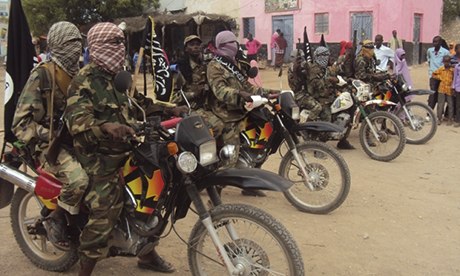
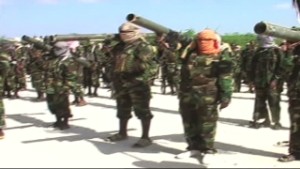
One of a number of propaganda photographs published on Somali websites, apparently from al-Shabaab strongholds, showing uniformed men riding on motorbikes.
A Kenyan soldier clambers up to his sentry post and stares out across vast plains of bush, acacia trees and red dust. The savanna is peaceful now, but he knows that when darkness falls the enemy will return, typically a band of 15 to 20 men armed with AK-47 rifles. "Every night they are in front of us," the soldier says. "They shoot and go. They run away."
Along the frontline, the Kenyans have piled clusters of green sandbags to provide cover. Behind them, a military base is protected by high walls crowned with razor wire. About 1,200 troops from Kenya and Sierra Leone are garrisoned in this desolate Somali hinterland. On an average day, green, heavily armoured vehicles set off to patrol the crucial port city of Kismayo, running the gauntlet of roadside bombs, a deadly tactic imported from Afghanistan and Iraq. In punishing heat, soldiers can be seen rolling a surveillance drone across the tarmac of the Italian-built airport.
This is where the war on terror in east Africa is being waged. Troops from the African Union and the fledgling Somali national army are battling al-Shabaab, the extremist Islamist group notorious for carrying out beheadings, recruiting boys to fight and forcing girls into marriage that claimed responsibility for last month's attack on the Westgate mall in Nairobi, which claimed 70 victims.
Some analysts interpreted the Kenyan atrocity as a sign of weakness, the thrashings of a dying animal. But there are signs that al-Shabaab is regrouping and evolving, recruiting members more quickly than it loses them and, in the words of Somalia's president, becoming "an extended hand of al-Qaida". Officials admit that, after forcing al-Shabaab out of the capital, Mogadishu, in 2011 and Kismayo in 2012, the campaign against it has lost momentum and stalled. Military maps show swaths of red labelled "AS infested area", while the African Union force, Amisom, lacks a single helicopter in a country similar in size to Afghanistan.
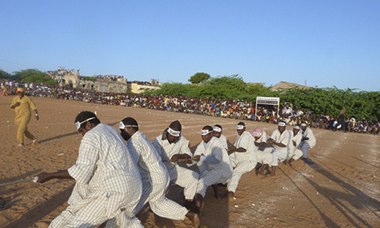
A series of propaganda photographs published on Somali websites last week, apparently from al-Shabaab strongholds, show uniformed men riding through town on motorbikes and in pickup trucks, with banners celebrating the Westgate attack and, bizarrely, sporting contests such as a tug-of-war and an egg-and-spoon race. Children feature heavily in the images. "This is intended as a message they are still alive," one Somali government official said.
While a UN report in 2011 put al-Shabaab's strength at about 5,000 fighters, a Kenyan military intelligence officer serving with Amisom put the true figure almost three times higher, and probably growing. The group may have lost key urban centres, but it still controls a third of Somalia's total territory, he estimates.
"Al-Shabaab trains its recruits on a daily basis," said the officer, who did not wish to be named. "They train more new troops than are killed, so they could even be increasing. They are powerful and you cannot underestimate them. They are still very active, not in fighting but in moving, especially in areas they control."
The organisation has turned to improvised explosive devices (IEDs) to attack Amisom convoys, already injuring four Kenyans who had to be evacuated home. "They bury them along routes where they expect our troops to go then spring the ambush. We cannot rule out support by al-Qaida," said the officer. "We're not sure they're getting logistical support, but they are getting expertise. Some of the IEDs we come across are not locally assembled; they are assembled with foreign expertise."
The officer added that he had heard unconfirmed reports that the Briton Samantha Lewthwaite, the so-called "white widow" wanted by Interpol, was operating in the mountains of Somalia's Puntland province. He also cast doubt on claims that US-born "jihadist rapper" Omar Hammami had perished last month after falling out with al-Shabaab's leadership: "There is no confirmation he has been killed. They are rumours. I believe he is still around."
Nevertheless, al-Shabaab is understood to be suffering logistical problems, shortages of ammunition and recent internal power struggles, though it appears that the hardline Ahmed Abdi Godane has emerged supreme. Witnesses say that he maintains control over towns such as Barawe with just a handful of armed loyalists, whose presence is enough to instil fear and obedience.
Al-Shabaab (the Youth) first emerged as the radical youth wing of Somalia's now defunct Union of Islamic Courts in 2006. It filled a vacuum, imposing a strict version of sharia law in areas under its control, including stoning to death women accused of adultery and amputating the hands of thieves. It soon nurtured ambitions to join forces with al-Qaida, but was reportedly rebuffed by Osama bin Laden, who warned in a letter that it was causing too many civilian casualties in Mogadishu. Bin Laden's death, however, removed that obstacle and al-Shabaab declared itself an al-Qaida affiliate early last year.
Questions remain over the precise nature of the relationship, but the year-old Somali government believes they are now virtually indistinguishable. "Al-Qaida and al-Shabaab, there's no difference here in Somalia: they are one," President Hassan Sheikh Mohamud told the Guardian in an interview in Mogadishu. "The leadership, the foreigners that are fighting here in Somalia, those who died here in Somalia, all of them were al-Qaida people.
al-shabaab propaganda Al-Shabaab forces in pickup trucks drive through a town. "Experts are sent by al-Qaida to train and arm and give all the new techniques of al-Qaida to al-Shabaab. Al-Shabaab is an affiliate, an extended hand of al-Qaida, there's no doubt, there's a lot of proofs of that."
Mohamud said there was no evidence the Westgate mall attack had been planned within Somalia or carried out by operatives from there, suggesting that al-Shabaab had common cause with allies across borders. "Al-Shabaab is an organisation that is based on certain ideologies and the ideology has no citizenship. This is the nature of this organisation: it's not domestic, it's not Somali only, this is an international regional organisation and its crimes have impacted at international and regional level. This is a threat to the region. So what we need as regional countries, within the framework of African Union, is to collaborate in order to uproot these evil forces."
Mohamud admitted that he had no idea of Lewthwaite's whereabouts. "These people move across borders; maybe if yesterday she was in Kenya, today she's somewhere else, maybe she's in Somalia or she's in Tanzania, Uganda or any other place. They can move, they can slip into the porous borders of the African countries."
The loss of ports and businesses has been a financial setback to al-Shabaab and, the president claimed, the government is now close to full control of the financial sector so that it can monitor incoming funds. But the Islamist group is said to run a parallel administration with strict discipline and greater efficiency, including accountants who impose taxes on goods, services and personal incomes.
The illicit trade in elephant ivory, smuggling of charcoal and expropriation of cash intended for respectable Islamic charities are among al-Shabaab's other revenue streams, generating between $70m and $100m a year (£43m-£62m), according to the UN. Some members of the Somali diaspora have also been implicated: two women in Minnesota were jailed after running a teleconference line in which al-Shabaab members openly solicited funds.
Officials fear that, in cities outside its control in Somalia and beyond, al-Shabaab will follow the al-Qaida textbook by diffusing into semi-autonomous cells plotting more attacks like Westgate. Few doubt that the group retains a lethal presence in Mogadishu despite the capital's tentative recovery. On 7 September, a car bomb exploded outside the Village, one of a chain of restaurants owned by British-trained chef Ahmed Jama. As people gathered to help, a suicide bomber in a soldier's uniform blew himself up, killing 15 people and maiming several others. Jama was in his car, having driven away just five minutes earlier.
"It was a big boom, something I never heard before in my life, like a two-tonne explosion," he recalled, pointing to dark scorch marks still visible in the parking bay. "I came back and it was a disaster. There were bodies burning. There was a small shop where a lady had been selling cigarettes and she was burning. Her sister, who had come from London, was screaming and died later in hospital."
Jama, who studied catering in Solihull and owns a restaurant in west London, considered quitting for the first time since he moved back to Somalia five years ago. Then RenƩ Redzepi of Danish restaurant Noma and other star chefs from around the world stepped in with a financial donation. "I was really close to the point of closing the restaurants," Jama admitted. "I have a wife and children who don't want to be here. But the world chefs touched me and made me feel like I should continue and not fear al-Shabaab. I was getting demoralised until then but it's given me new energy."
Sometimes the Village stays open until 2am, bringing a nightlife to Mogadishu that was unthinkable three years ago. Jama added: "I'm optimistic. The future is getting better. I came home in 2008 and every year is improving. It takes time. It needs patience." The war is being fought on fronts big and small. Last Friday, before prayers, saboteurs blew up a lamppost on one of Mogadishu's busiest thoroughfares. It seemed to be an attempt to disrupt efforts to make the streets feel safe again for pedestrians in the evening. In addition, one resident suggested, members of al-Shabaab are brainwashed into believing that lampposts have a sinister power and are "waiting for their deaths" so must be destroyed.
al-shabaab publicity As well as highlighting their military prowess, al-Shabaab propaganda photos published on Somali websites also show men involved in tug-of-war games. At Lido beach each Friday there is a festival mood and constant hubbub as thousands of young people gather, kicking a football, performing gymnastics or simply bracing in the sea and letting the surf wash over them. Girls laugh and frolic joyfully in the water, their brightly coloured jilbabs soaking as the tide comes in. "I think it's fantastic, it's vibrant and it's really a testimony that peace is coming back to Mogadishu and Somalia," said human rights activist Farida Simba, sitting in a packed beachside restaurant that opened a few months ago.
Simba's organisation, the African Initiative for Women in Africa, works with the mothers of young men recruited by al-Shabaab. The main reasons they join al-Shabaab, she said, are poverty and lack of education. "The mothers had no choice but to let young men go. The recruiters would go to the families and give them $50. They were poor and had no choice." Recruiters also use physical force, or indoctrination in madrasas, or threaten to kill the families of young men unless they join, she added. "The mothers feel helpless."
Such evidence exposes the limitations of a purely military solution, even as the African Union has called for a "surge" of more than 6,000 troops to take Amisom's strength up to around 23,000. Kismayo may have been liberated, but its 300,000 population suffers deficiencies in food and clean water, medical facilities, basic infrastructure and state schooling. On Tuesday, there was a not a single ship in port.
The absence of a functioning jail means uncertainty over what to do with al-Shabaab members who are captured or who defect. There is no programme for defectors' rehabilitation and reintegration into society.
Most of the Somali population are children or teenagers who have known only conflict and have little prospect of a job. "Al-Shabaab is both an organisation and an idea," a local politician told visiting European ambassadors in Kismayo on Tuesday. "You might be able to defeat the organisation, but the idea is still there. You must invest in education."
Officials express frustration that, despite a number of high-profile conferences, the international community is proving slow to offer practical support. Mohamud, described by critics as weak and lacking political acumen, said: "The world has to focus on one thing and only one: support the Somali government to control its own territory. Blaming, finger-pointing will not help at all.
"Unless that state and its institutions are there and control the territory, we will always have dark holes where al-Shabaab and others can go. Yesterday it was al-Qaida/al-Shabaab, the other day it was the piracy, tomorrow we don't know what will come out, and anything can come out unless there is a functioning Somali state that controls the Somali territory."

Tuesday, 29 October 2013

Al-Shabaab backed by money from U.S.

Al-Shabaab backed by money from U.S.

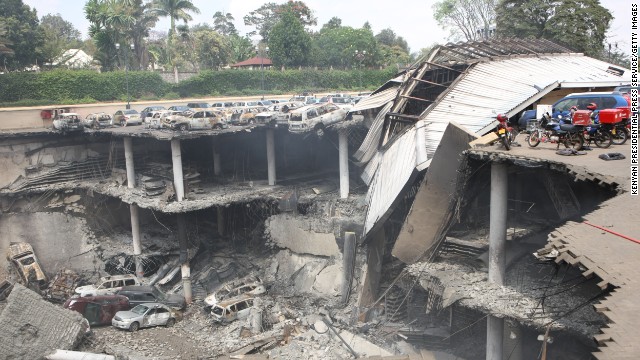
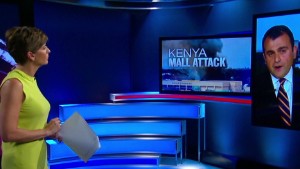
Images released by the Kenyan Presidential Press Service on Thursday, September 26, show scenes of destruction in the parking deck outside the Westgate mall after the four-day siege by militants. Images released by the Kenyan Presidential Press Service on Thursday, September 26, show scenes of destruction in the parking deck outside the Westgate mall after the four-day siege by militants.
<
1
2
3
4
5
6
7
>
>>


STORY HIGHLIGHTS
  • Bergen: Al-Shabaab bolstered not only by U.S. recruits but also by U.S. financial backers
  • He says the terrorist group has received illegal funding from sympathizers in the U.S.
  • U.S. authorities have succeeded in prosecuting Al-Shabaab supporters, Bergen says
Editor's note: Peter Bergen is CNN's national security analyst, a director at the New America Foundation and the author of "Manhunt: The Ten-Year Search for bin Laden -- From 9/11 to Abbottabad." David Sterman is a graduate student at Georgetown University's Security Studies Program.
(CNN) -- After the attack on the Westgate mall in Nairobi, Kenya, substantial attention was given to the some 40 Americans who have traveled to fight for Al-Shabaab in Somalia during the past several years.
But much less attention has focused on Al-Shabaab's supporters in the United States who have helped to fund the terrorist group. Those supporters have funneled tens of thousands of dollars via money transfer businesses to the terrorist organization and have often maintained direct contact with Al-Shabaab leaders and fighters in Somalia.
After the 9/11 attacks, when it became clear to investigators that al Qaeda's deadly assaults on New York and Washington had cost as much as $500,000 to mount, the U.S. government became far more aggressive about trying to block funds going to terrorist organizations.
Peter Bergen
Peter Bergen
Part of that process involved a determined effort to sort through which groups were terrorist organizations. On 9/11 there were only 26 terrorist groups on the State Department's list of designated Foreign Terrorist Organizations. Today there are 51, among them Al-Shabaab, which was designated in March 2008.
The result of that designation was that it was now illegal for a person in the United States to knowingly provide Al-Shabaab with money, training, expertise, false documentation, communications equipment, weapons or explosives, or to join the group.
On that basis, a number of cases have emerged:
• In Rochester, Minnesota, two women from Somalia who had become naturalized U.S. citizens helped organize funding for Al-Shabaab. Hawo Hassan, a 64-year-old adult day care worker, and Amina Farah Ali, 35, set up a dedicated teleconference line to raise funds for Al-Shabaab.
 
How Al-Shabaab recruits in the U.S.
 
On GPS: Somali president on Al-Shabaab
 
Bergen: Unlikely women were attackers
Hundreds of interested individuals called in to these teleconferences, and after each one Hassan and Ali recorded pledges of funds from the callers. After a teleconference on October 26, 2008, the two women received pledges from 21 individuals totaling $2,100 in funds for Al-Shabaab.
These teleconferences often featured Al-Shabaab figures. In one teleconference, an Al-Shabaab female leader exhorted the listening audience to send funds. In another, Mahad Karate, the head of Al-Shabaab's intelligence wing, told the members of the listening audience that jihad "is waged financially" and that their help was needed.
The two female Al-Shabaab fund-raisers also went door to door in Minnesota to raise contributions, often under false pretenses claiming contributions were for war orphans in Somalia. During a phone call with her Al-Shabaab financial contact, Ali stated, "I tell the people to collect money in the name of the poor. Nobody is aware of the money I send to you."
Prosecutors said it was clear from the phone conversations that they monitored that the two women knew that they were raising money for Al-Shabaab, a group that had been designated a terrorist organization by the U.S. State Department. Both women were convicted of providing funds to Al-Shabaab and were sentenced to lengthy prison terms this year.
• Similarly, Ahmed Hussein Mahamud, a 27-year-old man, raised money from the Minnesota Somali community under the pretense that the money was going to a local mosque or to help orphans in Somalia. Instead he transferred the funds to fellow conspirators who had traveled from Minnesota to fight in Somalia to help them buy weapons. He and his co-conspirators transferred $1,500 to help Al-Shabaab. Mahamud pleaded guilty last year.
• Nima Ali Yusuf, a 25-year-old San Diego woman, who pleaded guilty in December 2011 to sending $1,450 to help fund Al-Shabaab, was in telephone contact with some of the Somali-American men fighting in Somalia for Al-Shabaab.
• In 2007, Aden Hashi Ayrow, a Al-Shabaab leader, contacted Basaaly Saeed Moalin, a cabdriver in San Diego, asking him to fund his group. In January 2008, Ayrow told Moalin that he needed to know how much money was being sent monthly to his group, even if it was only $100, because even relatively small amounts of money could make a big difference in Somalia, which is one of the poorest countries in the world. To keep an Al-Shabaab foot soldier in the field only cost a dollar a day.
At Ayrow's request, Moalin organized other members of the Somali-American community to help provide funding. Moalin recruited three others members of the Somali-American community and together they sent $8,500 to Al-Shabaab between 2007 and 2008. All four were later convicted of providing support to Al-Shabaab.
• Another Al-Shabaab supporter in St Louis, cabdriver Mohamud Abdi Yusuf, was part of a group of men that sent $21,000 to Kenya and Somalia for Al-Shabaab. Yusuf pleaded guilty to giving support to the terrorist group.
Since Al-Shabaab was designated as a terrorist organization, the U.S. Justice Department has mounted "Operation Rhino" to combat Al-Shabaab's support network in the States and has convicted 12 individuals for providing funds to Al-Shabaab, according to a count by the New America Foundation.
This seems to have had a real deterrent effect. As a result of the publicity these cases have had in the Somali-American community, indictments for Al-Shabaab fund-raising have slowed considerably. And the last time a Somali-American was indicted for raising money for Al-Shabaab was 2011.

WHO HAS RIGHT TO DRIVE BETWEEN MEN AND WOMEN????

Women who defied Saudi driving ban fear repercussions

By Mohammed Jamjoom, CNN
October 29, 2013 -- Updated 0946 GMT (1746 HKT)
Watch this video

Saudi women defy driving ban

STORY HIGHLIGHTS
  • NEW: U.S. supports women's "ability to drive," State Department official says
  • The Women's Driving Campaign event on Saturday drew many supporters
  • Some women who participated now fear repercussions
  • Religious edicts have been interpreted as meaning women shouldn't drive
(CNN) -- Several women who publicly supported a campaign to defy Saudi Arabia's de facto ban on women driving fear they are being followed and investigated by the country's secret police.
The women, who requested anonymity due to their concerns for their safety, described to CNN Monday how they'd been "followed by cars filled with men since Saturday," when dozens of women across the kingdom participated in the October 26 Women's Driving Campaign.
At least five women said vehicles had been parked outside their houses since Saturday.
"I don't know for sure if it is secret police or just men trying to harass us because we want the right to drive, but they are trying to intimidate us," said one woman.
Saudi women's driving protest kicks off
"I'm positive I'm being followed by the secret police since Saturday," said another, who added she'd gotten no official word she was being investigated.
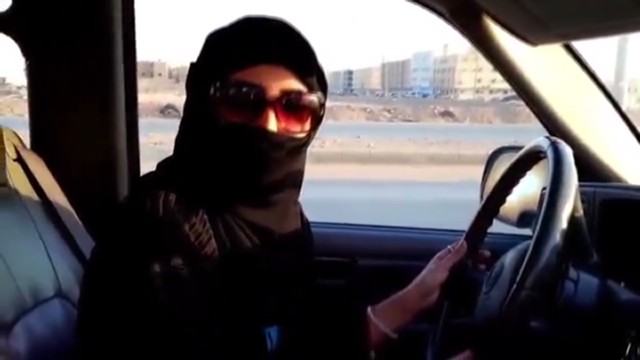
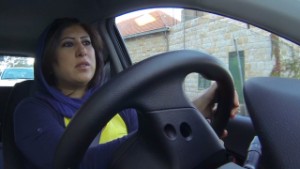
Over the weekend, in an extraordinary act of civil disobedience, at least 41 women got behind the wheel and drove on the streets of various Saudi cities. Many filmed themselves and uploaded those videos to YouTube.
Now, several of them say the euphoria of that moment has quickly turned to worry over what might happen to them next. Many wonder if they'll be punished for hitting the open road in such a closed society.
While no formal law exists in Saudi Arabia specifically barring women from driving, religious edicts are often interpreted there to mean it is illegal for females to do so. Other Saudi women have been penalized in the past for defying the ban.
In 1990, a group of 47 women protested the prohibition by driving through the streets of Riyadh, the country's capital. After being arrested, many lost their jobs and were placed under a travel ban.
In 2011, women's rights activist Manal Al-Sharif spent nine days in jail for posting online a video of herself driving.
Adding to their fears, the women say, is the detention of a man who worked closely with the campaign. They say Tariq Al-Mubarak, a columnist and teacher, was called in for questioning by the Bureau of Investigation and Prosecution in Riyadh on Sunday and has not been released yet.
Saudi Arabia's Interior Ministry would neither confirm nor deny if Al-Mubarak was being held. Reached via text message, Maj. Gen. Mansour Al-Turki, the Interior Ministry's spokesman, responded to CNN, saying, "as far as I know, the Bureau of Investigation (BIP) doesn't detain anybody, but they could call people for questioning or interrogation."
Despite repeated attempts, CNN was unable to reach the BIP for comment and was told by Al-Turki that the agency has no spokesperson.
When asked if Saudi women who participated in or supported the women's driving campaign were being targeted, followed or investigated, Al-Turki told CNN, "I don't understand the reason to follow anybody. If we have anything against anyone we would act according to the laws."
One woman, whose worry is growing by the hour, said participants in the movement only wanted to "emphasize to the Saudi government that this campaign is not a challenge to the Saudi government."
She described the campaign, which has gained serious momentum since it was first announced in late September, as "just following up on King Abdullah and other officials' words in the past that the women's driving issue is one for society to decide."
"We just want to be allowed to drive our own cars," she said.
Saudi Arabia is still very much split over the question of women driving, with many women there supporting not just the driving ban, but also in favor of the conservative kingdom's guardianship system, which mandates that Saudi women cannot go to school, get a job or even travel without permission from their male guardians.
Asked about the issue at a regular briefing Monday, a spokeswoman for the U.S. State Department voiced support for Saudi women's "ability to drive."
"We support, of course, the right of women everywhere to make their own decisions about their lives and their futures, and the right to benefit equally from public services and protection from discrimination," said Jen Psaki, the spokeswoman. "We support the full inclusion of women in Saudi society."
She said that the Unites States raises "human rights issues, equal rights issues, frequently with the Saudi government."

Angela Merkel's indignation over NSA spying is genuine and rightly so

 Opinion: Angela Merkel's indignation over NSA spying is genuine and rightly so
By Charlotte Potts, Special for CNN
October 29, 2013 -- Updated 1642 GMT (0042 HKT)

Watch this video
Editor's note: Charlotte Potts is a German national who has worked as a journalist and producer for both major German TV networks, ARD and ZDF, in Washington, DC. She reported on the 2008 and 2012 US campaigns and elections for a German audience and currently covers politics and society across the US. Follow her on Twitter @charlottecpotts
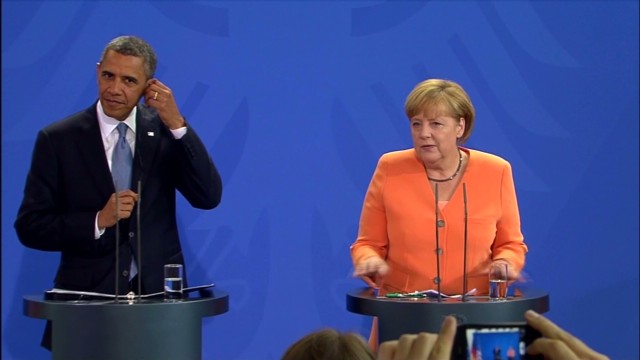
Washington (CNN) -- Angela Merkel might be the most powerful female politician in the world these days. She certainly is in Europe. We now know that her cell phone was monitored by U.S. intelligence, not just since she became the German Chancellor in 2005, but also for an additional three years before that.
Many U.S. analysts are now arguing that Merkel's anger at the revelations is manufactured for public consumption. They could not be more wrong.
A lot of Germans were flustered when they learned this summer that the NSA had been collecting millions of bits of so-called meta-data on them. According to opinion polls, 60% of Germans supported Edward Snowden's release of classified information. Just 17% found what he did was wrong.
Charlotte Potts
 
Reporter: Germans disappointed by spying
 
Greenwald: U.S.spying not about terrorism
For Germans, the discussion about U.S. surveillance is not a joke. In fact, it couldn't be more serious. We value our privacy highly. It is seen as an individual liberty that often could not be taken for granted in German history. Both the Nazi secret police -- the Gestapo -- and the East German intelligence agency -- the Stasi -- spied extensively on citizens.
Even in more recent decades Germans have repeatedly fought battles about privacy and against a perceived "Überwachungsstaat" -- or "surveillance state." Compared to the U.S., Germany already has many laws concerning data privacy, but two-thirds of Germans would even like stricter regulations.
Back in the summer, Merkel tried to downplay the U.S. surveillance herself and stood strong on the side of the U.S. ally. In mid-July, Merkel gave an interview on the topic, which in light of the recent revelations, seems almost satirical.
The host of the show introduced her as "the lady who hopes that at least her cell phone is bug-proof, even from U.S. intelligence services." Merkel said later in the interview: "I know that I am not being monitored."
A month later -- and in the midst of an election campaign dominated by this issue -- the German government announced that the "NSA scandal," as the German media called it, was over because the U.S. had ensured more transparency. The German public's anger calmed and Merkel cruised to re-election.
Last week Merkel learned in a particularly personal way that the issue is far from over.
She became Germany's first NSA victim known by name and gave the extent of U.S. spying a face.
Politically Merkel didn't have a lot to gain by bringing this issue to the table again. Her anger is not simulated for domestic consumption. In fact, the opposite is true, since she is now criticized for not taking the extent of the surveillance more serious in the beginning.
Merkel is usually measured. For her to pick up the phone and call President Barack Obama to publicly criticise the extent of U.S. surveillance shows how disgruntled she really is. Her anger seems real and rightfully so.
Eavesdropping on Merkel's conversations and reading her text messages is completely unacceptable. Not because she is the most powerful female politician, but because she is one of the closest allies the U.S. has in Europe and, overall, a trusted friend.
Back in the summer, Obama said that if he wanted to know what Merkel is thinking, he could pick up the phone and just ask her.
In retrospect, this comment verges on the offensive. So what benefit does it really bring to spy on Germany? Are these benefits really worth the costs? Even if Obama has begun a foreign policy shift towards Asia in his presidency, he still needs strong transatlantic partners.
Of course, the "Handyüberwachung" -- the German word for spying on cell phones -- hits close to home for Merkel.
She grew up in Eastern Germany where every conversation, every step, was monitored by the Stasi.
It's in part because of her past that Merkel always had a lot of respect for the United States. She values freedom and liberties and with that the country, which seemed to value these attributes the most: The United States.
Merkel wouldn't challenge relationships with the U.S. if she didn't think it was necessary. She wouldn't endanger the Swift data exchange agreement and negotiations on a free trade zone between the European Union and the United States, just to demonstrate that she is a strong leader or to strengthen her position at home, which is stable regardless at the moment.
Ever since World War II, German-U.S. relations have flourished through trust in each other. That trust is broken now. For the first time it seems, the U.S. has crossed an actual threshold.
Tapping the phones of ally leaders shouldn't be a question of "can we", but rather "should we?"
Now it is time for the U.S. to try to understand those cultural concerns, to show Europeans that security doesn't trump liberty; that the intelligence services haven't gone wild and, especially, to rebuild the trust of a valued ally.

How Steve Biko died...

How Steve Biko died

Biko - the Biography by Dr Xolela Mangcu
His death by torture, at the hands of the police, robbed South Africa of one of its most gifted leaders.
Below in an excerpt from Biko – A Biography, Mangcu describes Biko's arrest and how he was killed.
The Arrest
At the roadblock the police asked Steve and Jones to step out and open the boot. Jones, who was driving, followed their orders but struggled to open the boot. The car’s boot had to be opened in a special way, known only to Rams Ramokgopa, back at Zanempilo.
Apparently, the car had been in a minor accident resulting in a small dent above the left tail-light that jammed the lid. Whilst Jones tugged at the boot, the police kept accusing him of being a terrorist on his way to see Steve Biko, while Steve sat quietly in the passenger seat. Jones tried to make light of his struggle with the boot and invited one of the policemen to have a try. 
After a while the senior officer, Colonel Alf Oosthuizen, ordered the unit to clear the roadblock and to take Steve and Jones to the nearby police station in Grahamstown.
Oosthuizen drove with Steve in Ramokopa’s car while Jones drove with the other officers. The police searched the car thoroughly at the police station. Jones recalls that “they even went through the ash in the ash-tray. It was now clear that this was not a joke.”
They found Jones’s wallet, which, apart from an amount of R43, contained his identity document. And then Oosthuizen bellowed in Afrikaans: “As jy Peter Cyril Jones is, dan wie is daai groot man?” – If you are Peter Cyril Jones, then who is that big man?
Steve realised how awkward the situation was for his friend. On principle, Jones would not reveal Steve’s identity, exposing himself to torture and imprisonment. Yet in the end the police would find out anyway. Steve interjected: “I am Bantu Steve Biko.”
And then there was silence. “Biko?” retorted Oosthuizen, mispronouncing the B. “No, Bantu Steve Biko,” retorted Biko, pronouncing the Bs in his name silently.
The two men were separated. Jones was taken to Algoa Police Station and Steve to Walmer Police Station, both in Port Elizabeth, about 250 km from King William’s Town.
I was in front  and Steve was a couple of paces behind me.  My entourage stopped at a Kombi and I was told to enter and lie face down on the floor between the seats. I turned to look at Steve who had just passed us and I called his name out loud. He stopped to look at me and called my name and we smiled a greeting which was interrupted when I was slapped violently into the Kombi. This was the last time I ever saw my comrade – alive or dead.
Over the next months Jones was repeatedly interrogated and tortured. He was detained for nearly eighteen months. 
During the height of my interrogation there wasn’t a spot on my body that wasn’t either swollen, bruised or sensitive. At times, I struggled to find a comfortable sleeping position, resorting to sleeping in a kneeling position with my forehead resting on the floor.
How Steve Was Killed
At Walmer Police Station Steve was kept naked and manacled for 20 days before being transferred to the notorious Sanlam Building in Port Elizabeth. The security police there resented the respect Steve enjoyed from the King William’s Town security police. Stories had reached them that Steve had, in a previous stint in detention, even fought back and had punched one of the senior officers in King William’s Town, Warrant Officer Hattingh.
When he arrived at the Sanlam Building the security police told him to remain standing. After a while he sat down. That was when one of the policemen, Captain Siebert, grabbed him and pulled him back onto his feet. A “scuffle” ensued, and true to what he had told Sonwabo Yengo, Steve would defend himself.
On 6 September Steve sustained a massive brain haemorrhage. The cause of his death was not disputed: complications resulting from a brain injury. Steve suffered at least three brain lesions occasioned by the application of force to his head; the injury was suffered between the night of 6 September and 07:30 on 7 September.
In their amnesty application the policemen who killed Steve tried to evade spelling out what exactly had happened in the same way that they had during the original Biko Inquest in 1977. The details are not fully known. However, they admitted that after Steve had suffered a brain injury, they still kept him in a standing position. They shackled his hands and feet to the metal grille of the cell door. The police noticed that he was speaking with a slur but would not relent and continued with their interrogation.
Equally complicit in Steve’s murder were three doctors involved in the case, the district surgeon Dr Ivor Lang, the chief district surgeon Dr Benjamin Tucker and Dr Colin Hersch, a specialist from Port Elizabeth.
On September 7, one day after Steve suffered the brain haemorrhage, the police called in Dr Lang. Lang could find nothing wrong with Steve, despite the fact that he found him in a daze with a badly swollen face, hands and feet.
Instead the doctor alleged that Steve was “shamming”. Lang’s more senior colleague, Dr Benjamin Tucker, was called in for his opinion on what should be done. Tucker suggested that Steve be taken to hospital, but the police strongly objected, and Tucker subordinated his Hippocratic oath to their wishes.
Lang, even though he was acutely aware of Steve’s condition, recommended that Steve be driven 700 kilometres to the prison hospital in Pretoria. By 10 September Steve’s condition had deteriorated alarmingly. The following day, September 11, the police put Steve in the back of a Land Rover and drove him for more than twelve hours from Port Elizabeth to Pretoria – naked, manacled and unconscious.
On September 12 Steve Biko died, in the words of Sydney Kentridge, “a miserable and lonely death on a mat on a stone floor in a prison cell”.
The minister of justice and the police, Jimmy Kruger, issued a statement that Biko had died from a hunger strike. Addressing a National Party Congress, Kruger proclaimed to laughter:“I am not saddened by Biko’s death and I am not mad. His death leaves me cold.” Kruger’s remark reverberated around the world.
Speaking at the first Steve Biko Memorial Lecture 23 years later, UCT Vice-Chancellor Njabulo Ndebele described this callous event as:
. . . a continuum of indescribable insensitivity that begins as soon as Steve Biko and Peter Jones are arrested at a roadblock near Grahamstown on 18 August 1977. It starts with lowly police officers who make the arrest in the relative secrecy of a remote setting and ends with a remarkable public flourish, when a minister of government declares that Biko’s death leaves him cold. This situation lets us deep into the ethical and moral condition of Afrikanerdom, which not only shaped apartheid, but also was itself deeply shaped by it.
Here is how Barney Pityana describes his friend’s last hours:
On the night of 11 September Biko, evidently a seriously ill patient, was driven to Pretoria, naked and manacled to the floor of a Land Rover. Eleven hours later he was carried into the hospital at Pretoria Central Prison and left on the floor of a cell. Several hours later he was given an intravenous drip by a newly qualified doctor who had no information about him other than that he was refusing to eat. Sometime during the night of 12 September Steve Biko died, unattended.
News of Steve’s death instantly reverberated around the world. While there had been deaths in detention before, no one thought that, in their savage madness, the security police would kill someone with the stature of Steve Biko.

10 things you didn't know about Nelson Mandela

10 things you didn't know about Nelson Mandela

He may be one of the most famous men in the world, but there's plenty to learn about him.

By

Melissa Breyer
Related Topics:
Activism, Politics
Nelson Mandela
Nelson Mandela in 1937 and 2008. (Photos: Wikimedia Commons)
Most of us know Nelson Mandela as the South African revolutionary and politician whose long imprisonment became a rallying cry for dismantling apartheid. We know that he went on to be elected the first black president of the Republic of South Africa in the first open election in the country's history and that he has remained one of the most inspiring and admired men in modern history.
 
But there’s so much more to know. Consider the following:
 
1. His parents didn't name him Nelson
Upon his birth on July 18, 1918, he was named Rolihlahla Dalibhunga Mandela. He attended primary school in Qunu where his teacher gave him the name Nelson, in accordance with the tradition of giving “Christian” names to students.
 
2. He was a poor student
Mandela was expelled from the University College of Fort Hare for his participation in a student protest. He completed his BA through the University of South Africa before attending the University of the Witwatersrand for his law degree. By his own admission, he was not a very good student and left in 1948 without graduating; he also was unable to complete a law degree that he started at the University of London. It wasn’t until his last months in prison that he obtained his undergraduate law degree. He now has more than 50 honorary degrees from international universities.
 
3. He traveled under an alias
In 1962, he took on the alias David Motsamayi and secretly left South Africa for other parts of Africa and England to rally support for the liberation movement and the African National Congress (ANC); he received military training in Morocco and Ethiopia.
 
4. He was a master of disguise
Forced to go underground to evade the police, Mandela disguised himself as a chauffeur, a chef and a garden boy. “I would wear the blue overalls of the fieldworker and often wore round, rimless glasses known as Mazzawati teaglasses. I had a car and I wore a chauffeur's cap with my overalls. The pose of chauffeur was convenient because I could travel under the pretext of driving my master's car,” he wrote in his autobiography, "Long Walk to Freedom."
 
5. Some of his most famous words were spoken in court
In 1963, Mandela and nine others went on trial for sabotage in what became known as the Rivonia Trial, when he delivered his famous speech in which he concluded, “During my lifetime I have dedicated myself to this struggle of the African people. I have fought against white domination, and I have fought against black domination. I have cherished the ideal of a democratic and free society in which all persons live together in harmony and with equal opportunities. It is an ideal which I hope to live for and to achieve. But if needs be, it is an ideal for which I am prepared to die.” Facing the death penalty, they were convicted and sentenced to life imprisonment.
 
6. His principles were more important than freedom
He spent 27 years in prison until his release in 1990, nine days after the unbanning of the ANC. Throughout his imprisonment he had rejected at least three conditional offers of release.
 
7. He was deluged with ticker tape
In 1990, he embarked on a world tour, visiting British Prime Minister Margaret Thatcher, the U.S. Congress, and U.S. President George H.W. Bush. An estimated 400,000 attended a ticker tape parade through the canyons of Wall Street in his honor.
 
8. He loves tripe
Umleqwa (farm chicken), ulusu (tripe), and amasi (sour milk) are among his favorite foods. His chef since 1992, Xoliswa Ndoyiya, published a cookbook with his favorite recipes.
 
9. He was a concert promoter
Mandela was the driving force behind the 2003 AIDS awareness event in Cape Town called the 46664 Concert. The huge event included performances by Beyonce, Peter Gabriel, Bono, Bob Geldof and many more. The name of the concert references Mandela’s prison number.
 
10. His honors have no limits
Mandela has received more than 695 awards, including the Nobel Peace Prize and the U.S. Congressional Medal. In addition to his honorary degrees, he has also been bestowed with honorary citizenships, organization memberships, and a large number of streets, buildings, schools and other various things have been named for him — and his influence can even be seen in Hollywood. In "The Cosby Show," the grandchildren of Cliff and Clair Huxtable, Winnie and Nelson Tibideau, were named after Mandela and his former wife.