Thursday, 31 October 2013

DEADLINE OF CHEMICAL WEAPONS in SYRIA

Syria has met first chemical weapons destruction deadline, OPCW says

By Laura Smith-Spark, CNN
October 31, 2013 -- Updated 1456 GMT (2256 HKT)
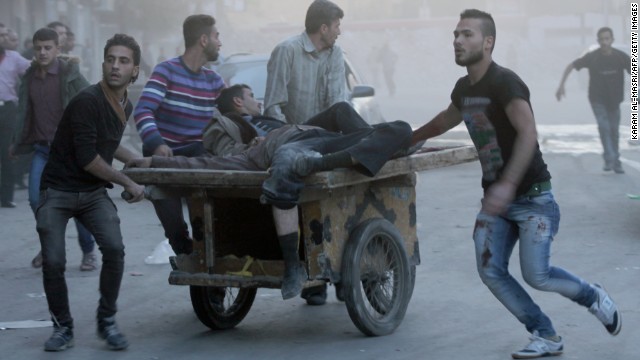
Two injured men are transported on a cart in Aleppo, Syria, following shelling as fighting between pro-government forces and rebels continues on Saturday, October 26. More than 100,000 people have been killed, according to the United Nations, and millions uprooted from their homes and tens of thousands trapped by the relentless fighting since 2011. Click through to view the most compelling images taken since the start of the conflict. Two injured men are transported on a cart in Aleppo, Syria, following shelling as fighting between pro-government forces and rebels continues on Saturday, October 26. More than 100,000 people have been killed, according to the United Nations, and millions uprooted from their homes and tens of thousands trapped by the relentless fighting since 2011. Click through to view the most compelling images taken since the start of the conflict.
(CNN) -- Syria has destroyed all its declared chemical weapons mixing, filling and production facilities, and all of the chemical weapons at inspected sites have been placed under seal, the Organisation for the Prohibition of Chemical Weapons said Thursday.
The watchdog body's announcement of the facilities' destruction means that the first deadline has been met in an ambitious program to eliminate the country's entire chemical weapons stockpile by the middle of next year.
The joint United Nations-OPCW mission visited 21 out of 23 sites, the OPCW statement said, and 39 of the 41 facilities at those sites.
The remaining two sites were too dangerous for the inspectors to go to, it said, but Syria had declared those sites as abandoned. The chemical weapons equipment there was moved to other sites, which were inspected.
The OPCW said it was "now satisfied that it has verified -- and seen destroyed -- all of Syria's declared critical production and mixing/filling equipment."
Additionally, all of the chemical weapons at the inspected sites were placed under seal during the inspectors' visits over the past four weeks to prevent them from being used, OPCW spokesman Christian Chartier said.
However, at least one observer says questions remain. Because OPCW inspectors were unable to visit two of the sites, the watchdog "is only certifying functional destruction of Syrian self-declared equipment from self-declared sites," David Reeths, director of aerospace and defense consulting for IHS Jane's, said in a statement.
The OPCW announcement is "a significant milestone" -- and it's "remarkable" that the OPCW was able to destroy the equipment in a conflict zone -- but Syria still has its stockpile of functioning chemical weapons, "so destruction of the production equipment has little to no impact on their immediate capabilities. Only after those weapons have been destroyed or removed from Syrian control will the state be demilitarized," said Reeths, a former treaty compliance officer for the U.S. military.
Other concerns are that the OPCW didn't have enough time after the declaration to "look for inconsistencies with their own intelligence" and whether the Syrian regime can be trusted to disclose all of its capabilities, he said.
"Syria likely assesses there is little chance that lack of candor in their declaration will be discovered in the short-term," Reeths said.
'Most challenging mission ever'
Eight inspectors who have been in Syria as part of an advance team that arrived on October 1 have now returned to the Netherlands, where the OPCW is based, said its director general, Ahmet Uzumcu.
He praised the "fortitude and courage" they had shown in "fulfilling the most challenging mission ever undertaken by this organization."
No further inspections are currently planned, given the progress made, the statement said.
The next milestone for the mission will be November 15, it said, when the body's executive council must approve a detailed plan submitted by Syria for the destruction of its chemical weapons stockpile.
There was no let-up Thursday in the violence that has raged for more than 2½ years in Syria.
The opposition Local Coordination Committees of Syria reported shelling in the Yarmouk and Tishreen areas of Damascus and intermittent clashes between the Free Syrian Army and government forces in the Damascus suburbs.
Talks with al-Assad
Diplomatic moves toward ending the conflict -- in which more than 100,000 people have died, according to U.N. estimates -- continued this week.
U.N. envoy to Syria Lakhdar Brahimi talked with Syrian President Bashar al-Assad in Damascus on Wednesday in their first meeting since December.
Brahimi spoke to al-Assad about the framework for holding a planned conference involving all parties in the conflict in Geneva, Switzerland.
Al-Assad told Brahimi that any political solution to the crisis in Syria hinges on outside countries cutting off support to the rebels, according to state-run media.
"Any success for any political solution must be linked to the end of any military support to military groups and to pressure the countries that are supporting these groups and are facilitating the entry of the terrorists and mercenaries into Syria by providing money and military support," al-Assad said during the meeting, according to Syrian state television.
He added, "This is an important step to prepare the framework to allow a national dialogue and put clear mechanisms to reach the desired objectives at the upcoming peace talks."
The Syrian conflict began in March 2011 after government forces cracked down on peaceful protesters during the Arab Spring movement and is now a full-blown civil war.

DID THE M23 SURRENDERED OR NOT?????

Congo troops, U.N. force drive M23 rebels from last bastion

A top M23 leader flees to Uganda, and the group's headquarters, Bunagana, falls in a stunning and swift reversal.


Congolese army supporters
Residents cheer this week as Congolese soldiers pass through Rugare after recapturing it from M23 rebels over the weekend. (Joseph Kay / Associated Press / October 28, 2013)


JOHANNESBURG, South Africa — Congolese troops backed by a U.N. force on Wednesday drove insurgents from the M23 group from their last stronghold in eastern Congo, raising hopes that the government might defeat the rebels and begin to bring some stability to the troubled region.
Bertrand Bisimwa, civilian leader with the M23 rebels, reportedly fled across the border into Uganda, with Congolese officials calling on authorities there to hand him over.
The fall of Bunagana, the rebels' headquarters, follows intense fighting in the eastern reaches of the Democratic Republic of Congo after the collapse of peace talks last week over M23's demands that its leaders receive amnesty. In recent days, Congolese forces have seized control of successive towns in the east, and U.N. agencies report that thousands of civilians have fled the fighting.
M23's reversal was stunning and swift, and underscores the success of a new United Nations approach in the area after the deployment of a new, more aggressive and focused U.N. intervention force with a stronger mandate to fight armed militias threatening civilians.
The group's setback also underscores the determination of regional leaders, including South African President Jacob Zuma, to stabilize the troubled region, which has been mired for decades in conflict and poverty. South African and Tanzanian forces form the backbone of the 3,000-strong intervention force.
Congolese President Joseph Kabila had made it clear that M23 leaders wanted for crimes against humanity would not receive amnesty or be integrated into the national army, as had been negotiated in previous peace agreements.
M23 emerged in April 2012 and took control of a large swath of eastern Congo, including the city of Goma last November for 10 days, reportedly funding its advances with gold and other minerals from the resource-rich territory. But the group was riven by infighting, underscored when one of the main M23 leaders, Bosco Ntaganda, surrendered at the U.S. Embassy in Rwanda in March. He was handed over to the International Criminal Court in The Hague to face charges of crimes against humanity.
Rwanda, which U.N. experts believe helps arm, fund and lead M23, has been under severe pressure from the White House and State Department to stop backing a group whose leaders are accused of war crimes, including recruitment of child soldiers. Rwanda, which is accused of backing M23 as a counter to anti-Rwandan rebels based in the east and even of coveting control of the resource-rich area, has always denied involvement.
Analyst Ben Shepherd, of the London-based think tank Chatham House, said M23's loss of Bunagana was a major development that provided a window for the international community to try to bring peace to the region.
"It's interesting to think that this may mark the genuine moment when Congo becomes a post-conflict country," Shepherd said, adding that the outright defeat of a Rwandan-backed militia was unprecedented.
He said the support of the U.N. intervention force by regional leaders made it difficult for Rwanda to continue backing M23 or another militia in Congo.
"For Rwanda to now attempt to go back to the same playbook that they used in the region in the late '90s, I think they'd find that very difficult, because the pattern's become familiar and it's become increasingly hard for them to avoid those allegations," he said.
"The tectonic plates of the region shifting is inescapable, and it's quite hard to see circumstances under which you'd get a repetition of the same old pattern of foreign-sponsored armed groups."
The next key issue is whether Congolese and U.N. forces will move to confront and defeat the myriad remaining armed groups in the region, notably the Democratic Forces for the Liberation of Rwanda, or FDLR, which includes some leaders of the 1994 genocide in Rwanda and is seen by Rwanda as a serious threat.
Human Rights Watch researcher in eastern Congo Ida Sawyer said the U.N. intervention brigade, with its tougher approach to militias, was a turning point in M23's rollback.
"I think with the M23 they've shown that they're willing to take more risks and be more robust than the U.N. peacekeepers here have in the past," Sawyer said. "The key challenge will be how the government is able to hold new territories that are taken over from armed groups and establish capability. A key weakness is the almost nonexistence of state authority and control in much of eastern Congo."
Sawyer said one of the reasons that the region had lapsed back into conflict so many times was the past practice of offering amnesties to rebel leaders and folding their fighters back into the army.
"I think we're getting there in terms of starting to address the root causes that have allowed the conflict to continue for so long, and one of those issues is impunity and the cycle of integrating rebels into the army, rewarding war criminals and zero accountability for abuses," Sawyer said. "At least one positive sign is that the government is saying the right thing about ending impunity and about accountability for army abuses as well as rebel leaders' accountability for abuses."
The M23 Twitter feed said Tuesday that its retreat was strategic and not a sign of weakness. The rebels vowed that they would emerge victorious.
"Those who think dat M23 is finishd sees near like pig, But eagles who sees far knos that dis is the begining of the most waited Battle," the group tweeted Wednesday, using Twitter shorthand.
But analysts dismissed M23's assertion, saying the rebels had abandoned areas it only recently fortified and had clearly suffered a crushing loss. The U.N.'s impending deployment of its first drone in eastern Congo also will make it difficult for M23 to regroup in force.
robyn.dixon@latimes.com

TANZANIA DECRIES NEGLECT BY EAC MEMBERS....

Tanzania decries neglect by EAC member states, eyes partnership with DRC

Updated Thursday, October 31st 2013 at 11:08 GMT +3
From Right: Presidents Uhuru Kenyatta (Kenya), Paul kagame (Rwanda) and Yoweri Museveni (Uganda) during the during the 3rd infrastructure summit in Rwanda. (Photo:PSCU)
By Philip Mwakio
Mombasa, Kenya: Tanzania has hit out at the move by Kenya, Uganda and Rwanda to sign tripartite agreements without it and is now eyeing closer relations with the mineral rich Democratic Republic of Congo (DRC).
The Tanzanians are leading a UN military force trying to stabilise the East of the former Zaire, an intervention that has strained relations with Rwanda which is believed to support rebels in the Congo.
Lately Tanzania has been expelling nationals from EAC member states for a variety of reasons.
Tanzania occupies almost half of the total land mass in EAC but was not represented during Monday’s signing of the Single Customs Territory in Kigali, Rwanda.
In a move likely to heighten tension within the larger East African Community (EAC) economic bloc, Tanzania’s minister for East African Co-operation, Mr Samuel Sitta is quoted in Citizen Daily, Tanzanian newspaper as saying that Tanzania has not been sitting pretty as it is excluded by the three member states.
‘’We are not idle. With clear signals that we are being sidelined alongside Burundi, we are focusing our engagements with DRC whom we believe has great economic potential,’’ Sitta is reported saying.
Tanzania is keen to develop the railway line project that will connect Uvinza in Kigoma along the shores of Lake Tanganyika to Msongati in the DRC.
“Our problem now is that a road linking us to Goma in DRC traverses Rwanda. The Uvinza-Msongati link will solve it,” he said.
The minister added that, Tanzania-Burundi closeness would be cost-effective for the latter’s business community members, through reliance on the nearer Dar es Salaam port, against the farther Mombasa option by 900 kilometres.
He noted that a Bujumbura businessman who opts for Mombasa port route travels 900km more compared to the one who uses Dar port.
For some months now, the Kenya-Uganda-Rwanda triumvirate has been driving the integration agenda to the exclusion of Tanzania and Burundi, with whom they are supposed to operate the five-member EAC grouping.
The triumvirate, branded by a section of the media as a coalition of the willing, has gone to the extent of discussing a protocol for speeding up the formation of a political federation.
However, Mr Sitta appeared to be cautious when reacting to questions from Members of Parliament, stressing that time was not yet ripe for Tanzania to take bold steps as a reaction to the goings-on in the rest of the bloc.
“It pains us if our partners are acting behind our back. But on this issue my advice is that we heed the advice of former President Ali Hassan Mwinyi; that, the best way of dealing with a liar is to give him space,” he said.
Mr Sitta noted that as a precaution, the government was now very cautious on its engagements in EAC activities. He explained that since the ‘coalition’ had sometimes been inviting Tanzania to their events, the government had been careful on where it sent its representatives.
Mr Sitta stressed that it was too early for Tanzania to take concrete steps even to condemn what the three partners are doing until more information is gathered.
He said so far the government has tasked the chairman of the EAC Council of Ministers (Uganda) to seek clarification as to what the three countries are doing and brief Tanzania and the rest of the members.
“We are expecting to meet in two weeks’ time in Arusha to receive a report from the chairman of the Council of Ministers. From there we will have more ground to determine the next course of action,” Sitta reportedly said.
A section of Tanzanian legislators have been  pressurising the government to either withdraw from the EAC and talk with other neighbouring countries to establish another regional grouping or halt Tanzania’s engagement in the regional activities.
Tough talking Tanzanian Minister for Foreign and International Co-operation, Mr Bernard Membe is reported to have said that what Tanzania was waiting for was only a divorce from its EAC partners.

CASH TRANSFERS FROM MINERALS:FROM AFRICA

Cash Transfers from Mineral Resource Wealth: Evidence from Africa

In a previous post, Maniza Naqvi discussed how cash transfers from natural resource wealth revenues have the potential to reduce poverty in resource-rich countries. In this post, she discusses how direct dividends from natural resource wealth could benefit the African continent.
Marcelo Giugale, World Bank’s Director of Economic Policy and Poverty Reduction Programs for Africa, makes the case with enthusiasm for direct cash payments from natural resource revenues to the citizens of a country: a mechanism by which citizens of a nation, share in its wealth earnings while making sure that the earnings keep growing for future generations. Iran and Alaska share mineral revenues with citizens through the Alaska Permanent Fund and the Iran Citizens Income Scheme. Why aren’t other countries, rich in mineral and hydro-carbon wealth on their way to doing the same?
Photo Credit: Flickr via ENOUGH Project
It is time to transform the discussion on economic growth drivers and development aid by adding the distribution of mineral revenues into the equation.
Africa, for example, has mineral revenues and much more that have the potential to reduce poverty. It seems, that whatever the so-called developed world craves, Africa already has: from mineral resources to deposits of diamonds, oils, rare earth; to agriculture land. Yet, these resources do not always benefit the continent. It is time to transform the discussion on economic growth drivers and development aid by adding into the equation the distribution of mineral revenues urges Shantayanan Devarajan, World Bank’s Chief Economist for the Middle East and North Africa and until recently for the Africa Region.
Yet, this is left out of the latest discussions, in the public square of elite policy making. Current discussions on the growth from the mining sector still revolve around direct and indirect jobs created through mining and government investments in social and economic infrastructure on behalf of citizens. Most of the jobs in the increasingly mechanized mining sector are for a few highly skilled workers and do not have a widespread impact on poverty, points out Dena Ringold, World Bank Lead Economist and co author of the World Bank’s World Development Report on Jobs. The current job-centered discourse does not focus on giving agency to individuals and providing them with the cash for determining how they invest for their social and economic well-being.
Mineral rich countries may have had the potential for even greater gains in human development outcomes if they had adopted different policies for how they used mineral revenues. Take, for example, the following mineral rich countries with a high poverty head count: Equatorial Guinea (76.8%), Gabon (32.7%) and Angola (40.5%) and very low human development indicators, yet they have equal or higher per capita GDPs than the BRIC countries: Brazil, Russia, India and China. The Human Development Indicators in all four mineral rich countries are very low. Clearly, the mineral revenues haven’t been distributed to all and have not improved life for the poorest.
Safety net benefits in terms of cash transfer programs targeted to the poor exist only in ten of 35 mineral rich countries in Africa. These cash transfers cover less than 10% of the population and generally fall around US$15 per month equaling about 20% of household consumption. In each of these cases, it is donor financing, not revenues from the mineral wealth that account for 65% to 100% of the cash benefits!
The governance measures remain at a very low level in many countries, which begs the question of whether there would have been larger gains in the absence of the resources. Mineral revenues dwarf current aid flows. Aid originates from citizens tax money in developed countries “donated as charity” and goodwill, masking the billions in outflows from these mineral revenue rich impoverished countries.
When seen through this prism of mineral wealth in stark comparison to the poverty in the same countries and the examples of Iran and Alaska, a different light is shed on the prescriptions at global forums. If there ever was a sweet spot for perfect nationalization and poverty eradication then it would be through direct dividend payments.
Maniza Naqvi is a Senior Social Protection Specialist at the World Bank working on safety nets in Malawi and Ethiopia.  This is a version of a post that first appeared here.

TANZANIA'S SHOCKING VAST WEALTH


         Tanzania's shocking vast wealth
As massive poverty continues to rock the majority of Tanzanians, the latest data reveal that Tanzania`s wealth in terms of the top five metals out of eleven provable mineral deposits amounting to millions of tonnes.
It is hard to believe it, but that is the reality in a country where 38million plus population lives in abject poverty, below a dollar per day, while 89percent of the total population survive on a single meal per day.

According to a geological survey conducted last year by the ministry of energy and minerals, Tanzania has huge reserves in eleven key minerals which include gold, Nickel, Tanzanite, Diamonds, copper, Iron ore, coal, Limestone, soda ash, gypsum and phosphate.

The five key minerals and their provable amounts in brackets is Gold (2,222tones), Nickel (209million tones), Diamonds (Carat 50.9million), Copper (13.65million tones), and Iron ore (103million tones).

However since this was just a geological survey undertaken by experts last year, its actual result is approximated to be accurate by up to 70 percent.

So far, only three types of minerals - gold, diamonds, Tanzanite - are being fully mined by multinational companies which at the end of the day take 97percent, leaving only peanut to the original Tanzanian owners.

If well managed through sound, people-centered mining policies, the mining sector can catapult Tanzanians to the proverbial promised land in decades and generations to come.

Comparing these huge deposits and the actual situation of poverty in the country, the message that comes across one`s mind is that Tanzania is in what experts describe as `resource curse`.

The term `resource curse` refers to the observation that nations with rich endowments of natural resources (oil, metals, timber) often dramatically under-perform economically relative to what one would expect.

Common sense and simple economics suggest that countries blessed with an abundance of natural resources should live long and prosper.

Yet over many years, it has been observed that nations rich in oil, gas, or mineral resources have been disadvantaged in the drive for economic progress.

Why are we poor?

Perhaps the biggest question that begs an urgent answer is; why are we so poor despite having all these huge minerals deposits?

It is a question that policy makers and politicians have been avoiding to seek answers for.

Tanzania like many other African countries is highly blessed with rich natural resources, but its people are swimming in the deep sea of massive poverty.

But the appalling truth is that instead of financing people`s development, Africa's huge mineral resources were used to fund the brutal civil wars that ravaged millions of people during the past four decades.

Today in Africa only a few countries like Botswana, Ghana and South Africa have managed to use their natural resources, especially minerals, to facilitate development and welfare to their people.

This example is vividly manifested in the Democratic Republic of Congo, Sierra Leone, Ivory Coast, Nigeria, Sudan and Angola whereby masters of the wars used natural resources to finance their deadly power struggle.

However in Tanzania, there wasn`t any civil war apart from the role played by the founding President, (the late) Dr Julius Nyerere, in liberating Southern African countries during the nationalist struggle.

While it is an undeniable truth that the move to allow the private sector to participate in the mining industry was brilliant one, the truth is that due to poor policies introduced by the third phase government, the whole idea has become a disaster to Tanzanians.

This is well echoed in the lucrative mining industry which has been mainly benefiting multinational companies, while paying the government a small slice of the cake.

Last year, for instance, the Minister for Energy and Minerals, William Ngeleja, told the parliament that during the period between 2001 and 2006, Tanzania produced gold worth $2.6 billion (Tshs3.38 trillion), but the government earned only $78 million.
In simple arithmetic, this is just 3 percent of the total revenues generated from thousands of tonnes of gold produced in the Lake Victoria gold belt. It also shows that the government earned an average of $13 million annually during that period from the multibillion industry whose real investments currently is valued at $2.5 billion.
Tanzania's shocking vast wealth
As massive poverty continues to rock the majority of Tanzanians, the latest data reveal that Tanzania`s wealth in terms of the top five metals out of eleven provable mineral deposits amounting to millions of tonnes.
It is hard to believe it, but that is the reality in a country where 38million plus population lives in abject poverty, below a dollar per day, while 89percent of the total population survive on a single meal per day.

According to the available statistics from the mining industry, from June 2000 to December 2006, the two biggest gold mines in the country produced a total of 5,686,710 ounces of gold, which at the current gold price of $600 per ounce is valued at Tshs 4.3 trillion ($ 3.3 billion), but what the nation earned is frightening and a shame.

While mineral production has increased in Tanzania in the past few years with export per year estimated to be nearly $900 million (Tshs1.17 trillion), the contribution of the mining sector to the Gross Domestic Product (GDP) remains very minimal, accounting to 3 percent.

According to the National Economic Survey report released in 2006, the growth rate of mining and quarrying sector increased from 15.4 percent in 2004 to 15.7 percent in 2005, whereby the increment was attributed to new investments in Tulawaka gold mines in Biharamulo District, Kagera Region.

The report further states that, the contribution of the sector to GDP, which is the total value of goods and services produced in a country during a year, increased from 3.2 percent in 2004 to 3.5 percent in 2007.

SNOWDEN LEAKS

Snowden leaks: Google 'outraged' at alleged NSA hacking

A summary of US spying allegations brought about by Edward Snowden's leak of classified documents
Google has expressed outrage following a report that the US National Security Agency (NSA) has hacked its data links.
An executive at Google said it was not aware of the alleged activity, adding there was an "urgent need for reform".
The comments follow a Washington Post report based on leaks from Edward Snowden claiming that the NSA hacked links connecting data centres operated by Google and Yahoo.
The NSA's director said it had not had access to the companies' computers.
Gen Keith Alexander told Bloomberg TV: "We are not authorised to go into a US company's servers and take data."
But correspondents say this is not a direct denial of the latest claims.
'Extending encryption' The revelations stem from documents leaked by ex-US intelligence contractor Edward Snowden, who has been granted temporary asylum in Russia and is wanted in the US in connection with the unauthorised disclosures.
The documents say millions of records were gleaned daily from the internet giants' internal networks.
They suggest that the NSA intercepted the data at some point as it flowed through fibre-optic cables and other network equipment connecting the companies' data centres, rather than targeting the servers themselves.
Continue reading the main story

How intelligence is gathered

How intelligence is gathered
  • Accessing internet company data
  • Tapping fibre optic cables
  • Eavesdropping on phones
  • Targeted spying
The data was intercepted outside the US, the documents imply.
The data the agency obtained, which ranged from "metadata' to text, audio and video, were then sifted by an NSA programme called Muscular, operated with the NSA's British counterpart, GCHQ, the documents say.
The NSA already has "front-door" access to Google and Yahoo user accounts through a court-approved programme known as Prism.
Google's chief legal officer David Drummond said Google did not provide any government with access to its systems.
"We have long been concerned about the possibility of this kind of snooping, which is why we have continued to extend encryption across more and more Google services and links, especially the links in the slide," Drummond said in a statement.
"We are outraged at the lengths to which the government seems to have gone to intercept data from our private fibre networks, and it underscores the need for urgent reform."
A spokesperson for Yahoo said the company had "strict controls in place to protect the security of our data centres, and we have not given access to our data centres to the NSA or to any other government agency".
An NSA spokesperson denied a suggestion in the Washington Post article that the agency gathered "vast quantities of US persons' data from this type of collection".
 
NSA Director Gen Keith Alexander: "We do not have access to Google servers, Yahoo servers"
The latest revelations came hours after a German delegation of intelligence officials arrived in Washington for talks at the White House following claims that the US monitored Chancellor Angela Merkel's mobile phone.
Two of Mrs Merkel's most important advisers, foreign policy adviser Christoph Heusgen, and intelligence coordinator Guenter Heiss were sent to take part in the talks - seen as a measure of how seriously Mrs Merkel takes the matter.
Next week, the heads of Germany's spying agencies will meet their opposite numbers in Washington.
'Inappropriate and unacceptable' The head of US intelligence has defended the monitoring of foreign leaders as a key goal of operations but the US is facing growing anger over reports it spied on its allies abroad.
It has also been reported that the NSA monitored French diplomats in Washington and at the UN, and that it conducted surveillance on millions of French and Spanish telephone calls, among other operations against US allies.
Spanish Prime Minister Mariano Rajoy said that if Spain had been a target of the NSA, this would be "inappropriate and unacceptable between partners".
James Clapper said knowing what foreign leaders were thinking was critical to US policymaking
However, Gen Alexander has said "the assertions... that NSA collected tens of millions of phone calls [in Europe] are completely false".
On Wednesday, the agency denied Italian media reports that it had targeted communications at the Vatican.
The UN said it had received assurances that its communications "are not and will not be monitored" by American intelligence agencies, but refused to clarify whether they had been in the past.
On Tuesday, Director of National Intelligence James Clapper testified before the intelligence panel of the House of Representatives that much of the data cited by non-US news outlets was actually collected by European intelligence services and later shared with the NSA.
He said foreign allies spied on US officials and intelligence agencies as a matter of routine.

ZIDANE STATUE REMOVED IN QATAR....

Qatar removes Zidane headbutt statue from Corniche

Foreign workers shine Zinedine Zidane statue (file photo) 
 The statue of Zidane, by Adel Abdessemed, went on display on 3 October
A five-metre (16ft) bronze statue of French footballer Zinedine Zidane's infamous headbutt has been taken down from the Corniche in Doha, Qatar.
The sculpture was removed just weeks after being installed, having prompted strong reactions on social media.
It generated criticism from religious conservatives who believe it encourages idolatry; others thought it promoted violence or was in bad taste.
It portrays Zidane headbutting Italy's Marco Materazzi in the 2006 World Cup.
Created by Algerian-born French artist Adel Abdessemed in 2012, it had previously been on show at the Pompidou Centre in Paris. It was bought by the Qatari Museum Authority.
Local reports say the statue - known as Coup de Tete or headbutt - is going to be housed along with other works by Abdessemed in the Arab Museum of Modern Art.
'New idols' The Arabic hashtag "Zidane's statue in Qatar" triggered a "massive" reaction from dismayed conservatives on Twitter, said AFP, with one user sarcastically posting: "Congratulations for having new idols."
"It is sad that our youth see in this art and modernity. Our children do not differentiate between the right and the wrong, or the haram [prohibited] and the halal [permissible]," said another tweeter.
However another poster criticised the removal: "Seriously they moved the headbutt statue from the corniche? that's stupid."
"It definitely was relevant to football, a sport loved in this country! as for the culture, no relevance whatsoever," other comments said.
The statue's craftsmanship and symbolism were earlier praised as "timeless as Greek mythological works of art" by the Jean-Paul Engelen, director of Public Art at the Qatari Museum Authority.

THE SECRETS OF GERMAN ECONOMIC SUCCESS....

German economic strength: The secrets of success

German school children  
The German education system is much more geared to vocational training than many of its economic competitors
Imagine a country whose inhabitants work fewer hours than almost any others, whose workforce is not particularly productive and whose children spend less time at school than most of its neighbours.
Hardly a recipe for economic success, you might think.
But the country described above is none other than Germany, Europe's industrial powerhouse and the world's second largest exporter; a country whose economy has single-handedly stopped the eurozone falling back into recession and the only nation rich enough to save the euro.
When you consider that only the Dutch work fewer hours among the 34 members of the OECD, that German children spend 25% less time in the classroom than their Italian counterparts, and that there are six more productive economies in Europe alone, these facts appear all the more remarkable.
data on hours worked by country
So why is the German economy so powerful, and what lessons can the rest of us learn from it?
Euro bliss There is no doubt that Germany has benefited greatly from the euro.
By getting into bed with more sluggish economies in southern Europe, Germany adopted a much weaker currency than would otherwise have been the case - as one of the very few countries in the world running a balance of payments surplus, the deutschmark would have been a great deal stronger than the euro.
This has provided a terrific boost to German exports, which are cheaper to overseas consumers as a result.
But this goes only some way to explaining Germany's current economic might.
Just as important are the relatively low levels of private debt. While the rest of Europe gorged on cheap credit throughout the 1990s and 2000s, German companies and individuals refused to spend beyond their means.
One reason for this, says David Kohl, deputy chief economist at Frankfurt-based Julius Baer bank, is that real interest rates in Germany remained stable, unlike those in other European economies.
"In the UK, Italy, Spain and Portugal, for example, higher inflation meant real rates moved down, so there was a huge incentive to borrow money," he says.
But cultural differences are just as significant - quite simply, Germans are uncomfortable with the concept of borrowing money and prefer to live within their own means.
"In German, borrowing is 'schulden', [the same word for] guilt. There is an attitude that if you have to borrow, there is something wrong with you," says Mr Kohl.
This has been particularly beneficial to Germany in recent years - unlike its European counterparts, consumers and businesses did not need to slash spending to cut their debt levels when banks stopped lending during the recession.
Labour reforms But there are other, deep-rooted reasons behind Germany's current economic pre-eminence in Europe, not least in fact the relatively low number of hours spent at work and in the classroom.
Continue reading the main story

Most productive economies in OECD

Country GDP/hr worked
Source: OECD. Figures in $.
Norway
81.5
Luxembourg
78.9
Irish Republic
66.4
US
60.3
Netherlands
59.8
Belgium
59.2
France
57.7
Germany
55.3
Denmark
53.2
Switzerland
51.7
Germany embarked upon a programme of fundamental labour market reform in 2003, sparked by the excesses of post-unification wage increases.
Strong employment protection legislation and a degree of trust on behalf of the workforce in well-capitalised companies that had not over-borrowed, meant the Social Democratic government was able to use its close ties with labour unions to push for moderation in wage inflation.
The reforms laid the foundation for a stable and flexible labour market. While unemployment across Europe and the US soared during the global downturn, remarkably the jobless number in Germany barely flickered.
German workers were simply willing to work fewer hours, knowing that they would keep their jobs because of it.
They were all the more willing to do so due to the stronger bond that exists between workers and employers compared with many other countries.
"There is a culture of business owners acknowledging and rewarding the efforts of the workforce," says Andreas Woergoetter, head of country studies at the OECD's economics department.
No wonder, then, that Germans work fewer hours than most.
Job skills More important still to Germany's industrial strength is the country's education system.
Continue reading the main story

Hours spent at school, aged 7-14

Country Hours
Source: OECD. Selection of countries.
Italy
8316
Australia
7806
Netherlands
7700
France
7432
Spain
7364
England
7258
Germany
6362
Japan
6344
Greece
6340
Poland
4715
OECD average
6732
School finishes at lunchtime across much of Germany due to what Mr Woergoetter calls a "societal preference", designed to allow children to spend more time with their families.
But it's in the later years of schooling that the German model really stands apart.
"Half of all youngsters in upper secondary school are in vocational training, and half of these are in apprenticeships," says Mr Woergoetter.
Apprentices aged 15 to 16 spend more time in the workplace receiving on-the-job training than they do in school, and after three to four years are almost guaranteed a full-time job.
And in Germany, there is less stigma attached to vocational training and technical colleges than in many countries.
"They are not considered a dead end," says Mr Woergoetter. "In some countries, company management come from those who attended business school, but in Germany, if you're ambitious and talented, you can make it to the top of even the very biggest companies."
The German education system, therefore, provides a conveyor belt of highly skilled workers to meet the specific needs of the country's long-established and powerful manufacturing base, which is rooted in the stable, small-scale family businesses that have long provided the backbone of the economy.
Lessons learned There is clearly much to learn from the German model, but blind replication may not be the answer.
Mercedes sign 
 Germany is home to some of the world's best-known manufacturers
Many economies jealously covet Germany's manufacturing prowess, particularly while demand for its industrial products in emerging markets such as China continues to boom.
And yet, not so long ago, the roles were reversed.
"Ten years ago, we in Germany were looking at the much higher value-added potential of the UK service sector," says Mr Kohl.
"There are limits to adding value in manufacturing. If you want to be rich and move up the value chain, you need to be in services."
As unlikely as it seems, perhaps one day Germany will once again look to others for inspiration.

FROM SPYING CALLS TO economic POLICIES...

US criticises Germany and China policies

Cars being transported in Germany  
The US Treasury has blamed Germany's export-led growth model for dragging down eurozone
The US has criticised Germany's economic policies, saying that its export-led growth model is hurting the eurozone and the wider global economy.
In its biannual report, the US Treasury said that domestic demand growth in Germany had been "anaemic".
It also reiterated its view that the Chinese yuan, continues to remain "significantly undervalued".
The report has criticised Chinese policy before, but criticism of German economic policy is rarer.
"Germany's anaemic pace of domestic demand growth and dependence on exports have hampered rebalancing at a time when many other euro area countries have been under severe pressure to curb demand and compress imports in order to promote adjustment," the Treasury said.
"The net result has been a deflationary bias for the euro area as well as for the world economy."
'Bit strange' Germany is eurozone's largest economy has been one of its key drivers of growth in recent years.
Continue reading the main story.

Start Quote

It is better for eurozone to have a highly concentrated, efficient and skilled export powerhouse in Germany than not have any major engine of growth”
Tony Nash IHS
Its importance to the 17-nation bloc has only increased since the development of the region's debt crisis, which has impacted other bigger economies such as Italy and Spain.
It has been one of Europe's stronger economic performers and its exports prowess is seen as one of its key strengths.
The country narrowly avoided recession earlier this year, but GDP in the second quarter of 2013 was driven up by demand from both consumers and businesses.
Analysts said that while Germany could benefit from boosting domestic demand, the criticism levied on its policies was unfair.
"I think this is a bit strange," Tony Nash, vice president at IHS, told the BBC. "The eurozone has to get growth from somewhere and Germany is the most likely place for that to happen."
"And it is better for eurozone to have a highly concentrated, efficient and skilled export powerhouse in Germany than not have any major engine of growth," he added.
Yuan concerns In recent years, the US and many other economies have alleged that China tries to keep the value of its currency artificially low.
Continue reading the main story

US Dollar v Chinese Yuan

Last Updated at 31 Oct 2013, 07:06 GMT USD:CNY twelve month chart
$1 buys change %
6.0920 -
-0.00
-
-0.03
They say that, by doing so, Beijing gives an unfair advantage to its exporters as an undervalued currency makes its good cheaper to foreign buyers.
For its part, China has been looking to loosen its grip on the currency as it looks to push for a more global role for the yuan.
But Beijing has maintained that a sudden an sharp appreciation in the value of the yuan will hurt its overall economy.
The yuan has risen nearly 12% against the US dollar since June 2010.
While the Treasury acknowledged that the yuan had been rising, it said the appreciation was "not as fast or by as much as is needed".
"On the other hand, the evidence that China has resumed large-scale purchases of foreign exchange this year, despite having accumulated reserves that are more than sufficient by any measure, is suggestive of actions that are impeding market determination and a currency that is significantly undervalued," it added.
However, the report did not label China as a currency manipulator.

Wednesday, 30 October 2013

Spying scandal: Will the 'five eyes' club open up?

Spying scandal: Will the 'five eyes' club open up?

The US embassy in Berlin 
 Germany has suggested it may seek a no-spy deal with the US, whose embassy is beside Brandenburg Gate
The 'five eyes' club was born out of Britain and America's tight-knit intelligence partnership in World War II and particularly the work at Bletchley Park, breaking both German and Japanese codes.
Code-breakers realised collaboration helped in overcoming some of the technical challenges and in being able to intercept communications around the world.
Out of this experience came what was first called BRUSA and then rechristened UKUSA - a top secret intelligence-sharing alliance signed in March 1946.
The details of the original agreement were classified for decades but were finally revealed in 2010 when files were released by both countries.
The arrangement is described as "without parallel in the Western intelligence world".
Soon after the beginning of the Cold War, GCHQ and the NSA were born and the alliance formed the basis of their extremely tight co-operation during the Cold War - the real heart of what has been known as "the special relationship".
The club was also expanded to include three other English-speaking countries - Canada, Australia and New Zealand and so became known as the "five eyes".
So how does this club work? It is based on sharing with each other and not spying on each other.
The US and UK human intelligence services (the CIA and MI6) do not run operations inside the other's country without permission, but while the CIA and MI6 do share information they are not nearly as closely intertwined as their counterparts GCHQ and NSA. They deal in what is known as signals intelligence, which deals with communications.
Under UKUSA, they share nearly - but not quite - everything, and do not target each other's nationals without permission.
Barack Obama and Angela Merkel at a news conference in Berlin in June 
 The White House admits that the recent disclosures about US spying have caused diplomatic tension with America's allies
One document leaked by the fugitive Edward Snowden reveals that the protection extends when intelligence is shared with other countries outside the club (so called "third parties", a "second party" being any other member of the club).
Continue reading the main story

Start Quote

One general rule about intelligence is that the more a secret is shared, the less secret it becomes”
An agreement between the NSA and Israel published by the Guardian newspaper read that Israel "recognises that the NSA has agreements with Australia, Canada, New Zealand and the United Kingdom that require it to protect information associated with UK persons, Australian persons, Canadian persons and New Zealand persons using procedures and safeguards similar to those applied for US persons".
In a way, Edward Snowden himself shows how close the alliance is.
An American, he had access to thousands of documents belonging to British intelligence. And so GCHQ has, in a strange way, become a victim of the club's intimacy and openness within its wall.
But given America's NSA is the largest partner by some way, it may be careful not to complain too much.
Just because a country is not in the club does not mean there is no co-operation with those inside.
Americans suggest the reason they collect so much data about call-records from countries in Europe is that they are looking for suspected terrorist plots and that they share what they find with national intelligence agencies so they can then follow them up (this is the same justification that the NSA has furthered for collecting some domestic call record data within the US).
"If the French citizens knew exactly what that was about, they would be applauding and popping champagne corks. It's a good thing. It keeps the French safe. It keeps the US safe. It keeps our European allies safe," Congressman Mike Rogers, the chairman of the US House Intelligence Committee, which oversees the NSA, told CNN at the weekend.
Bombe decryption machine, designed by mathematician Alan Turing to decode German codes 
 GCHQ and NSA share intelligence about communications, using hi-tech versions of Alan Turing's WWII Bombe decryption machine (above)
But of course, while this might explain some of the spying, it does not explain eavesdropping on Angela Merkel's phone or bugging EU offices.
That looks like traditional state-on-state espionage and is what is likely to be most angering European officials (although for public consumption they still need to make angry noises and protests about the collection of their ordinary citizens' call records).
Germany and France have suggested they may seek deals to end this kind of state-on-state espionage activity and one of the interesting questions is the extent to which what they really want is a no-spy deal like the one Britain enjoys, and effective membership of the existing club (or some modified version of it).
However, one general rule about intelligence is that the more a secret is shared, the less secret it becomes.
It is one reason why some are sceptical of sharing too much intelligence with the whole EU - secrets may not stay secret among 28.
Could something be possible with some of the countries though?
Some senior British intelligence officials are understood to be supportive of deepening and broadening the partnership with some European allies, although whether this means going so far as letting then into full membership is another matter.
But with embarrassing revelations likely to continue, the way the club currently operates may well have to change.

Tiananmen crash: China police 'detain suspects'

Tiananmen crash: China police 'detain suspects'
Vehicles travel along Chang'an Avenue as smoke raises in front of a portrait of late Chinese Chairman Mao Zedong at Tiananmen Square in Beijing, 28 October 2013 The crash led to the square being evacuated and forced roads to close
Police in China have detained five suspects in connection with Monday's deadly car crash at Beijing's Tiananmen Square, state media report.
Police have described the incident as a "violent terror attack", the Xinhua news agency says, for first time.
All three people in the car had names from the Muslim Uighur minority in the restive western region of Xinjiang.
Two bystanders died and 38 people were injured after the vehicle crashed into a crowd and burst into flames.
The police said that what happened at Tiananmen Square was a "violent terrorist attack" which was "carefully planned and organised", Xinhua says.
Continue reading the main story

Uighurs and Xinjiang

  • Uighurs are ethnically Turkic Muslims
  • They make up about 45% of the region's population; 40% are Han Chinese
  • China re-established control in 1949 after crushing short-lived state of East Turkestan
  • Since then, there was large-scale immigration of Han Chinese
  • Uighurs fear erosion of traditional culture
The jeep that crashed into a bridge in front of the Forbidden City was driven by a man who was with his wife and mother, police said in a statement.
All three had names from the Muslim Uighur minority in the Xinjiang region.
The three ignited petrol inside the car, they added.
Police said the vehicle they found on Monday had a container for petrol, two knives and what they describe as a flag with extremist religious slogans on it. They added that the car's number plates were registered in Xinjiang province.
They said they also found more knives and another flag at a location in Beijing.
On Wednesday, a number of news agency reports said a police notice was being circulated among hotels in Beijing, asking information about eight suspects.
Seven have names typical of the Uighur ethnic group and the other, although seemingly from China's majority Han ethnicity, has an address in Xinjiang, reports say.
A tourist from the Philippines and a tourist from Guangdong province were among those killed in the incident. Another 38 people were injured, including three tourists from the Philippines and one from Japan.
Uighur complaints Police shut down the scene of the incident - at the north end of the square at an entrance to the Forbidden City - shortly after it occurred, temporarily closing a subway station and a road.
A BBC crew attempting to record footage at the location were briefly detained, while on Chinese social media some pictures of the scene appeared to be quickly deleted and comments were heavily censored.
Xinjiang is home to the minority Muslim Uighur group, some of whom complain of cultural and religious repression under Beijing's rule. There have been sporadic outbreaks of violence in Xinjiang, including in both Pishan and Shanshan counties. China says it grants the Uighurs wide-ranging freedoms.
In June, riots in Xingjian's Turpan prefecture, which is in Shanshan county, killed 27 people. State media said police opened fire after a mob armed with knives attacked police stations and a local government building.
In April another incident in the city of Kashgar left 21 people dead. The government said the violence was linked to terrorist activity, but local people told the BBC it involved a local family who had a longstanding dispute with officials over religious freedom.
Map of Tiananmen

US spy leaks: How Intelligence is Gathered

US spy leaks: How intelligence is gathered

US embassy in Berlin
Documents leaked by whistleblower Edward Snowden suggest the US government has undertaken mass surveillance operations across the globe - including eavesdropping on US allies.
The claims have led US Senate's intelligence committee to pledge to review the way the country's biggest intelligence organisation - the National Security Agency (NSA) - undertakes surveillance.
According to the leaks, what are the key methods the spy agency uses?
1. Accessing internet company data
How the Prism system is reported to work
In June, the leaked documents revealed how the NSA had backdoor access to major technology companies.
The files showed the agency had access to the servers of nine internet firms, including Facebook, Google, Microsoft and Yahoo, in order to track online communication under a surveillance programme known as Prism.
They claimed the project gave the NSA - along with the UK's eavesdropping station GCHQ - access to email, chat logs, stored data, voice traffic, file transfers and social networking data.
However, the companies denied they had offered the agency "direct access" to their servers.
Some experts have also questioned Prism's real power.
Digital forensics professor Peter Sommer told the BBC such access may be more akin to a "catflap" than a "backdoor", with intelligence agencies able to tap into servers only to collect intelligence on a named target.
Continue reading the main story

What data could Prism possibly access?

Company What kind of data which could be collected?
Microsoft logo Some Microsoft sites collect email address, name, home or work address, or telephone numbers. Some services require sign-in with email and password. Microsoft also receives information sent by web-browsers on sites visited, together with IP address, referring site address and time of visit. The company also uses cookies to provide more information about pages views

Yahoo logo Yahoo collects personal information when users sign up for products or services including name, address, birth date, post code and occupation. It also records information from users' computers, including IP addresses.

Google logo Personal details are required for sign-up to Google accounts, including name, email address and phone number. Google email - Gmail - stores email contacts and email threads for each account, which have a 10 GB capacity. Search queries, IP addresses, telephone log information and cookies which uniquely identify each account are also stored. Chat conversations are also collected unless a user selects 'off the record' option.

Facebook logo Facebook requires personal information on sign-up, such as name, email address, date of birth and gender. It also collects status updates, photos or videos shared, wall posts, comments on others posts, messages and chat conversations. Friends' names, and the email details of those friends who have provided addresses on their profiles, are also recorded. Tagging information about users from friends is recorded, and GPS or other location information is also stored.

Paltalk logo Paltalk is an instant chat, voice and video messaging service. Users must provide contact information including email address. The company employs cookies to track user behaviour, with the aim of delivering targeted advertising.

YouTube logo YouTube is owned by Google and the company applies the same data collection methods. Users logged in via their Google accounts will have their YouTube searches, playlists and subscriptions to other users' accounts recorded.

Skype logo Skype is part of Microsoft, and its instant messaging service replaced Microsoft's Messenger this year. Users submit personal data including name, username, address when signing up. Further profile information such as age, gender and preferred language are also recorded as options. Contacts lists are stored, as is location information from mobile devices. Instant messages, voicemail and video messages are generally stored by Skype for between 30 and 90 days, though users can opt to preserve their instant messaging history for longer.

AOL AOL collects personal information for users signing up or registering for its products and services, but its privacy policy states that users who do not make themselves known to the company by these methods are "generally anonymous."

Apple Users signing up for Apple ID's - required for services such as iTunes , or to register products - must submit personal data including name, address, email address and phone number. The company also collects information about the people who Apple users share content with, including their names and and email addresses.
Continue reading the main story
2. Tapping fibre optic cables
In June, further leaked documents from GCHQ published in the Guardian revealed the UK was tapping fibre-optic cables carrying global communications and sharing the data with the NSA, its US counterpart.
The documents claimed GCHQ was able to access 200 fibre-optic cables, giving it the ability to monitor up to 600 million communications every day.
The information on internet and phone use was allegedly stored for up to 30 days in order for it to be sifted and analysed.
GCHQ declined to comment on the claims but said its compliance with the law was "scrupulous".
Graphic showing all international network of undersea fibre-optic cables
In October, the Italian weekly L'Espresso published claims that GCHQ and the NSA had targeted three undersea cables with terminals in Italy, intercepting commercial and military data.
The three cables in Sicily were named as SeaMeWe3, SeaMeWe4 and Flag Europe-Asia.
3. Eavesdropping on phones In October, German media reported that the US had bugged German Chancellor Angela Merkel's phone for more than a decade - and that the surveillance only ended a few months ago.
Der Spiegel magazine, again quoting documents leaked by whistleblower Edward Snowden, suggested the US had been spying on Mrs Merkel's mobile phone since 2002.
The documents quoted by the magazine claimed a US listening unit was based inside its Berlin embassy - and similar operations were replicated in 80 locations around the world.
Investigative journalist Duncan Campbell explains in his blog how windowless areas on the outside of official buildings could be "radio windows". These external windows - made of a special material that does not conduct electricity - allow radio signals to pass through and reach collection and analysis equipment inside.
US embassy in Berlin The German press has published claims that the US taps communications from a small windowless room at its embassy in Berlin
Der Spiegel said the nature of the monitoring of Mrs Merkel's mobile phone was not clear from the leaked files.
However, later reports claimed that two of the chancellors phones had been targeted - one unencrypted phone she used for party business as well as her encrypted device used for government work.
According to security experts, standard mobile phone encryption systems can be vulnerable because their scrambling system is, in software terms, separate from the program used to create a message.
It is possible for an eavesdropper to position themselves between the message-making software and the encryption system at either end of a conversation and see information before it is scrambled or after it is unscrambled.
End-to-end encryption, now adopted by many, closes this gap by having the message-making software apply the scrambling directly. In addition, many of these systems run a closed network so messages never travel over the public internet and are only decrypted when they reach their intended recipient.
How encryption systems work
End-to-end encryption
As well as the bugging of the chancellor's phone, there are claims the NSA has monitored millions of telephone calls made by German and French citizens along with the emails and phone calls of the presidents of Mexico and Brazil.
The Guardian later reported that the NSA had monitored the phones of 35 world leaders after being given their numbers by another US government official. Again, Edward Snowden was the source of the report.
4. Targeted spying
Telecom network cables
Der Spiegel magazine published claims in June that the NSA had also spied on European Union offices in the US and Europe.
The magazine said it had seen documents leaked by Edward Snowden showing that the US had spied on EU internal computer networks in Washington and at the 27-member bloc's UN office in New York.
The files allegedly suggested that the NSA had also conducted an eavesdropping operation in a building in Brussels, where the EU Council of Ministers and the European Council were located.
Then, in July, the Guardian published claims in further leaked documents that a total of 38 embassies and missions had been "targets" of US spying operations.
Countries targeted included France, Italy and Greece, as well as America's non-European allies such as Japan, South Korea and India, the paper said.
EU embassies and missions in New York and Washington were also said to be under surveillance.
The file is said to have detailed "an extraordinary range" of spying methods used to intercept messages. They included bugs, specialised antennae and wire taps.

Germany's Merkel sends intelligence delegation to US


Germany's Merkel sends intelligence delegation to US

A summary of US spying allegations brought about by Edward Snowden's leak of classified documents

A German delegation of intelligence officials is in Washington for talks at the White House on Wednesday following claims that the US monitored Chancellor Angela Merkel's mobile phone.
The chancellor's foreign policy adviser and Germany's intelligence co-ordinator will hold talks at the White House.
The head of US intelligence has defended the monitoring of foreign leaders as a key goal of operations.
The US is facing growing anger over reports it spied on its allies abroad.
It has also been reported that the National Security Agency (NSA) monitored French diplomats in Washington and at the UN, and that it conducted surveillance on millions of French and Spanish telephone calls, among other operations against US allies.

Analysis

The measure of how seriously Chancellor Merkel takes the matter is that she has sent two of the most important people in her immediate circle of advisers: her foreign policy adviser, Christoph Heusgen, and the German government's intelligence coordinator, Guenter Heiss.
Next week, the heads of the actual spying agencies go to meet their opposite numbers in Washington.
This week's meetings are more about how to rebuild trust, while next week's agenda will be more about the detail of how the two countries' agencies might or might not work more in harmony.
The US has an agreement to share intelligence with Britain, New Zealand, Australia and Canada. It is not clear if Germany wants to be part of that.
There have been commentators in America saying that Germany is in a different position from the other countries mentioned because its future relationship with China is not clear.
On this argument, Germany's close trade links with China might make it loath to support the US in any future trans-Pacific confrontation.
However, NSA director Gen Keith Alexander said "the assertions... that NSA collected tens of millions of phone calls are completely false".
The revelations stem from documents leaked by fugitive ex-US intelligence contractor Edward Snowden, who now lives in Russia and is wanted in the US in connection with the unauthorised disclosures.
German media have reported that the US bugged German Chancellor Angela Merkel's phone for more than a decade - and that the surveillance only ended a few months ago.
Germany's delegation includes Christoph Heusgen, Mrs Merkel's foreign policy adviser, and Guenter Heiss, the secret service co-ordinator, said Caitlin Hayden, a spokeswoman for the US National Security Council.
US National Security Adviser Susan Rice, Director of National Intelligence James Clapper and Lisa Monaco, assistant to the president for homeland security and counterterrorism, are also expected to take part.
Ms Hayden said the meeting was part of the agreement reached between President Barack Obama and Chancellor Merkel last week to deepen US-German cooperation on intelligence matters.
'Basic tenet' The meeting comes just hours after Mr Clapper and Gen Alexander testified before the intelligence panel of the House of Representatives on Tuesday.

How intelligence is gathered

How intelligence is gathered
Gen Alexander said much of the data cited by non-US news outlets was actually collected by European intelligence services and later shared with the NSA.
Meanwhile, Mr Clapper told lawmakers that discerning foreign leaders' intentions was "a basic tenet of what we collect and analyse".
He said that foreign allies spy on US officials and intelligence agencies as a matter of routine.
Mr Clapper said the torrent of disclosures about American surveillance had been extremely damaging and that he anticipated more.
But he said there was no other country that had the magnitude of oversight that the US had, and that any mistakes that had been made were human or technical.
The BBC's Jonny Dymond in Washington says if anyone was expecting apologies or embarrassment from the leaders of America's intelligence community, they were in for a disappointment.
James Clapper said knowing what foreign leaders were thinking was critical to US policymaking
The intelligence pair were not given a tough time by the committee but that sentiment is turning within Congress toward tightening up the reach of American intelligence agencies, our correspondent says.
Meanwhile, the spokesman for Russian President Vladimir Putin has denied that Moscow used free USB memory sticks and mobile phone charging cables to spy on delegates attending the G20 Summit in St Petersburg last September.
Reports in two Italian newspapers suggested that the USB sticks and cables had bugs on them that could steal data from the delegates.
Spokesman Dmitri Peskov said the reports were an attempt to distract from the problems between European countries and the US.